I still remember the exact minute because the kitchen clock was ticking above the sink while my coffee went cold beside a plate I had not bothered to clear.
There was dish soap on my hands, lemon cleaner in the air, and the faint smell of ham glaze from the small dinner I had made for myself after church.
The house was peaceful in a way that almost felt kind.
Then my phone buzzed.
I looked down and saw Lily’s name.
For one second, I smiled.
A father does that before he knows better.
Then I answered, and my daughter’s voice came through broken, wet, and barely louder than a breath.
“Dad… please come get me.”
My hand tightened around the phone.
“Lily?”
“He hit me again.”
The words landed so hard the room seemed to tilt.
Behind her voice, I heard music playing, something classical and expensive, the kind Richard liked to put on at family gatherings so everyone could pretend he had taste instead of money.
I heard children laughing too.
That was the part that made my blood go cold.
There was one sharp scream, then the sound of the phone hitting the floor.
After that, all I heard was the music and those children laughing.
A father learns certain sounds.
He learns the difference between a daughter crying because life hurt her and a daughter crying because someone did.
Lily had called me from the shoulder of a highway when she was nineteen, shaking because her tire blew out in the rain.
She had called me from college after her first panic attack, convinced she was dying, while I talked her through breathing until dawn.
She had called me the night Richard proposed.
That call had stayed with me for reasons I did not want to admit.
She told me she was happy.
She said the ring was beautiful.
She laughed in all the right places.
But her laugh arrived half a second late.
That half second lived in the back of my mind for two years.
I had given Richard my handshake anyway.
I had given him my blessing.
I had given him the benefit of doubts I should have treated like warnings.
When I grabbed my keys, I did not think about traffic.
I did not think about Easter guests.
I did not think about whether I was overreacting.
I only saw Lily at six years old, asleep in the backseat after a long day at the county fair, holding a stuffed rabbit like it was the only thing keeping the world together.
Twenty minutes later, my pickup slammed into park outside Richard’s estate.
It was the kind of place that made ordinary men feel like they had dirt on their shoes before they got out of the truck.
The gate was black iron.
The driveway was long enough to make a statement.
White tents dotted the lawn, and pastel shirts flashed between trimmed hedges like some magazine version of Easter had been rented for the afternoon.
Music drifted from hidden speakers.
Painted eggs clicked into wicker baskets.
A caterer in a black shirt carried trays past a fountain like nothing inside that house could possibly be ugly.
Everything looked expensive.
Everything looked clean.
That was the lie.
I took the marble steps two at a time.
Before I reached the door, Richard’s mother stepped into the doorway with a mimosa in one hand and a diamond bracelet sliding down her wrist.
Her name was Margaret, but in my head I had always called her Mrs. Hale because she treated first names like something poor people used to pretend they were equal.
Her perfume reached me before her voice did.
Powdery, sharp, and mean.
“Go back to your lonely little house, Arthur,” she said.
I tried to step around her.
She moved with me, blocking the doorway.
“Lily is resting,” she said. “Do not bring your drama here and ruin our family holiday.”
“My daughter called me,” I said.
“Your daughter is married,” she replied. “This is her family now.”
Then she shoved me.
Hard.
My heel scraped against the porch stone.
For one ugly second, old instinct returned with perfect clarity.
I saw her wrist.
I saw the angle of her shoulder.
I saw three ways to move her without breaking anything and two ways that would not be so generous.
I did not touch her.
I had spent fifteen years teaching myself to be Lily’s father instead of the man I used to be.
So my rage did not explode.
It went quiet.
Quiet rage is different from anger.
Anger wants noise.
Quiet rage starts taking inventory.
I pushed past her and opened the door.
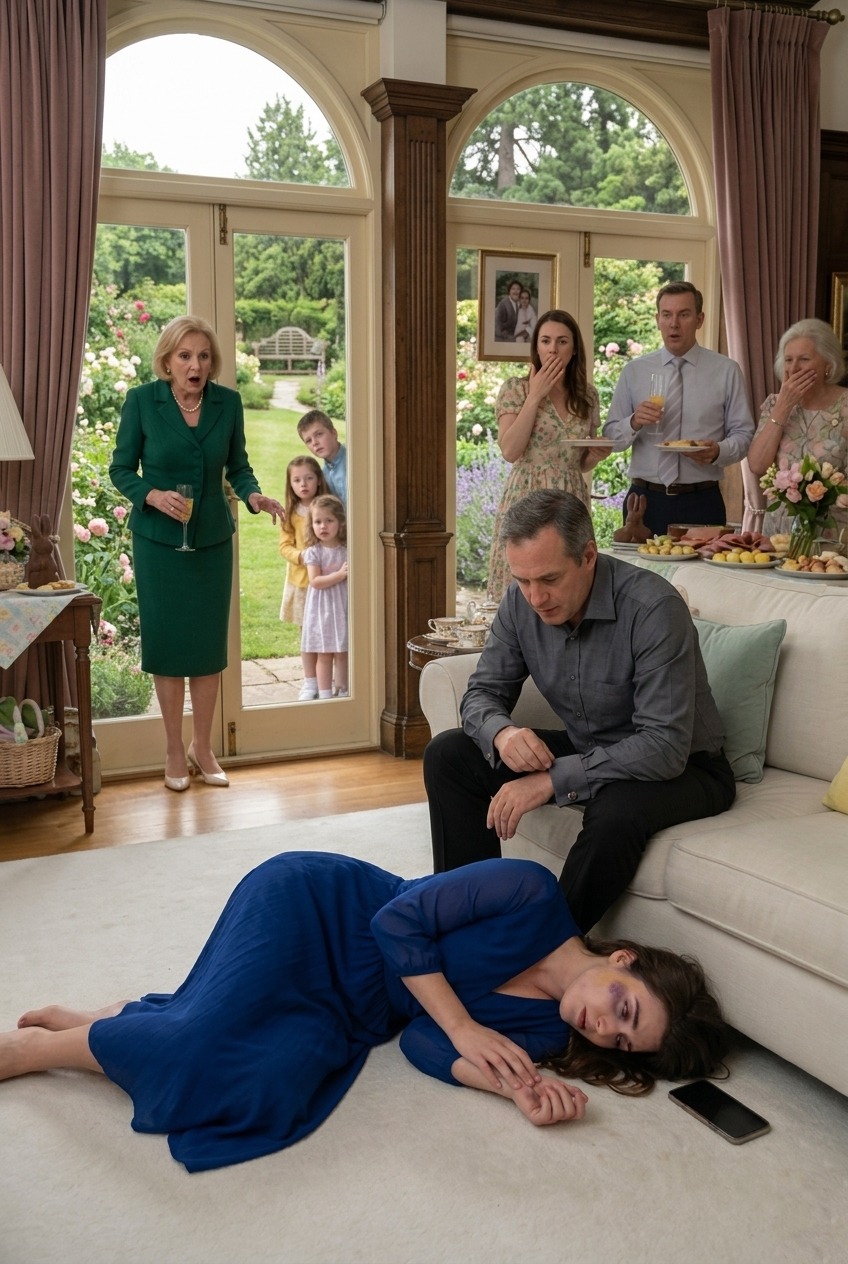
The living room froze in pieces.
A woman near the buffet stopped with a deviled egg halfway to her mouth.
A man in a linen jacket lowered his champagne glass but did not set it down.
Someone’s fork clicked once against china.
Through the back glass, children kept laughing on the patio because no adult had told them the world inside had split open.
Nobody came forward.
Nobody asked why I had burst in.
Nobody asked if Lily needed help.
Then I saw her.
My daughter was curled on her side in the center of a white rug so clean it made the blood stand out.
Her cheek was swollen.
One eye was already darkening.
Her lip was split.
Her hands were tucked close to her ribs as if she was trying to make herself smaller than the room.
There was a thin red line under her mouth.
Not much.
Enough.
Standing above her, adjusting the French cuffs of his shirt, was Richard.
My son-in-law.
The real estate mogul.
The smiling host.
The man who had once stood in my kitchen and promised me he would take care of her.
The man who accepted my trust like it was another property title he could file away.
He looked at me, then poured himself a Scotch.
His hand did not shake.
“Old man,” he said, “calm down.”
I crossed the room.
Lily flinched when my shadow touched her.
That hurt me more than seeing her blood.
I knelt beside her, but I did not move too fast.
“Lily,” I said. “It’s Dad.”
Her eyes opened just enough to find me.
The relief in them nearly broke me.
Richard sighed like I had interrupted dessert.
“She’s clumsy,” he said. “She tripped.”
I looked at Lily’s neck.
Four fingerprints.
One thumb mark.
No fall in the world leaves a hand around your throat.
“She tripped,” I said, “and left handprints on her own neck?”
Margaret stepped in behind me.
“Arthur, don’t be vulgar.”
Vulgar.
That was the word she chose.
Not cruel.
Not violent.
Not help her.
Vulgar.
Some families do not hide evil because they cannot see it.
They hide it because naming it would cost them something.
At 2:36 p.m., I saw the phone.
It was under the edge of the sofa, cracked across the screen.
Still glowing.
Still recording.
I saw blood on Richard’s cuff.
I saw Scotch on his breath.
I saw a smear on the rug.
I saw the guests who suddenly found the floor fascinating.
Through the back windows, I saw the local Chief of Police beside the barbecue, laughing with a paper plate in his hand.
That detail mattered.
Richard saw me notice.
His smile widened.
“There it is,” he said. “You finally understand.”
I said nothing.
He stepped closer with the Scotch glass loose in his fingers.
“Let me explain how the world works to a retired little nobody like you,” he said. “My family owns this town. The Chief is in my backyard right now, eating food I paid for. Go ahead. Call the cops. Let’s see who they put in handcuffs.”
A woman near the buffet looked away.
A man coughed into his fist.
Margaret lifted her chin as if Richard had made a reasonable point at a homeowners meeting.
He was right about one thing.
The usual road had already been blocked.
Conventional law in that town had been bought lunch and given a seat in the shade.
But Richard had made the mistake rich cowards always make.
He thought silence meant surrender.
He thought restraint meant fear.
He did not understand that some people go quiet because they are deciding exactly where the blade of consequence should fall.
I slid one arm under Lily’s shoulders.
She made a small sound and grabbed my sleeve.
“Dad,” she whispered, “don’t let him make me stay.”
“I won’t,” I said.
My voice sounded calmer than I felt.
“Not another minute.”
Richard laughed once.
“You walk out with her, Arthur, and I’ll have you arrested for kidnapping my wife.”
There are sentences that close a door.
There are sentences that open a grave.
That one did both.
My jaw locked so hard I tasted copper where I had bitten the inside of my cheek.
I looked at him over Lily’s head.
“You are going to deeply, profoundly regret saying that.”
For the first time, his smile twitched.
Not enough for anyone else to notice.
Enough for me.
I lifted Lily into my arms.
She weighed less than I remembered.
That is a terrible thing to notice about your grown child.
The party stayed frozen as I carried her through the living room.
Richard laughed behind me, louder than he needed to, performing confidence for people who no longer looked confident.
Margaret shouted something about disgrace.
A guest whispered my name.
Outside, the Easter lawn kept shining.
Children dropped painted eggs into wicker baskets.
Pastel shells clicked together in the warm afternoon light.
The world is cruel that way.
It keeps being pretty when people are bleeding.
At my truck, I laid Lily gently across the seat.
She tried to sit up.
I told her not to.
Her fingers were trembling around the edge of my jacket.
“My phone,” she whispered.
“I saw it.”
“It was recording.”
“I know.”
Her eyes closed again, and for one second I was back in a hospital room twenty-seven years earlier, holding a newborn so small I was afraid my hands were too rough for her.
I had promised her then that I would keep her safe.
I had failed more than once.
Not this time.
I reached beneath the dash and found the black case.
It had been tucked there for fifteen years.
I had not opened it since the day I decided to bury that life.
Not because I was ashamed of it.
Because Lily deserved a father who came home for dinner, not a ghost who measured every room by exits.
The latches opened with a sound I remembered too well.
Inside were three things Richard Hale did not know existed.
A military-grade satellite phone.
An emergency authentication card.
A laminated contact sheet from a life I never discussed at birthdays, graduations, or Thanksgiving tables.
Lily’s eyes opened halfway.
“Dad?”
“It’s all right.”
“You said you didn’t do that anymore.”
“I don’t.”
I looked toward the porch.
Richard had come outside now, Scotch in hand, grinning like he was still hosting.
Behind him, Margaret was saying something to the Chief near the patio doors.
The Chief looked my way.
He did not move toward Lily.
He did not call for an ambulance.
He looked at Richard first.
That told me everything.
I powered on the satellite phone.
The screen lit.
For a moment, my reflection stared back at me from the dark glass.
Older.
Grayer.
Still not harmless.
I entered the authentication code.
The line clicked once.
Then twice.
A voice answered.
Calm.
Male.
Familiar enough to drag fifteen years out of the ground.
“Status.”
I looked at my daughter.
I looked at Richard’s perfect house.
I looked at the Chief of Police laughing beside a barbecue while Lily bled in my passenger seat.
“We have a Code Black,” I said. “Burn it all down.”
There was no gasp.
No dramatic pause.
The people who knew that phrase had been trained not to waste breath.
“Arthur,” the voice said, “is the victim breathing and mobile?”
“Breathing,” I said. “Barely mobile.”
“Suspect?”
“Richard Hale. Husband. Real estate money. Local police compromised.”
“Evidence?”
“Phone recording still on scene. Visible injuries. Blood on suspect’s cuff. Multiple witnesses. Chief present and compromised.”
Lily moved beside me.
Her hand found my sleeve again.
“He said he owns them,” she whispered.
I repeated it into the phone.
“He verbally threatened to have me arrested if I removed her. Claimed the Chief was in his pocket.”
The line went silent for two seconds.
That was all.
Then I heard keys.
Fast.
Controlled.
Someone on the other end had already started moving people.
“Arthur,” the voice said, “listen carefully. Do not return inside. Do not engage the suspect. Do not surrender the victim to local law enforcement. Keep the line open.”
Richard stepped off the porch.
He spread his hands as if he were approaching a difficult client.
“Arthur,” he called, “let’s stop embarrassing ourselves.”
I looked at him through the windshield.
He was still smiling.
That smile had probably worked his whole life.
On investors.
On guests.
On police.
On frightened women who had been taught to keep family business behind closed doors.
But it did not work on me.
Margaret came down the steps behind him, fast and sharp.
Then she stopped.
Her gaze had dropped to the grass near the porch.
The cracked phone had slid there when I carried Lily out.
Its screen was still lit.
For the first time since I had met her, Margaret Hale looked afraid.
Not offended.
Not annoyed.
Afraid.
The mimosa slipped from her hand and shattered on the stone.
Richard turned toward her.
“What?”
She did not answer.
She only stared at the phone.
On my line, the calm voice said, “Arthur, confirm whether the suspect can see the recording device.”
“He can now.”
“Good.”
I heard another voice in the background.
Then another.
The old machine was waking up.
Richard’s smile began to drain.
He looked from his mother to the phone to me.
“What did you do?”
I did not answer.
He took another step.
The Chief appeared behind him, wiping barbecue sauce from his fingers with a napkin.
That detail, more than anything, made my stomach turn.
He looked at Lily through the windshield and still did not ask if she needed medical help.
He looked at Richard.
Then he looked at me.
“Arthur,” the Chief said, trying to sound friendly, “why don’t we calm this down?”
The voice in my ear said, “Is that the Chief?”
“Yes.”
“Keep him talking.”
I lowered my window two inches.
Not enough for anyone to reach in.
Just enough to let my voice carry.
“Chief, my daughter needs medical care.”
He smiled with tired patience, the way small men smile when power is borrowed.
“We will sort that out. First, I need everyone to stay put.”
“Does stay put mean you’re preventing me from taking an injured woman to a hospital?”
His smile tightened.
Richard snapped, “She is my wife.”
Lily flinched at the word.
I saw it.
So did the Chief.
He chose not to.
Power does not always announce itself with a badge or a bank account.
Sometimes it announces itself by what it refuses to see.
In my ear, the voice said, “We have enough. First unit is two minutes out.”
I kept my eyes on the Chief.
“Are you ordering me to hand her back to him?”
The Chief shifted.
For the first time, he noticed the phones.
Not just Lily’s cracked one in the grass.
Guests had started recording too.
One woman near the patio held her phone chest-high, pretending she was only clutching it.
A teenage boy near the egg table had his pointed straight at Richard.
Truth spreads faster when cowards realize it might save them.
Richard noticed a second later.
“Put those phones away,” he barked.
Nobody moved.
His mother whispered his name.
It was not a warning.
It was a plea.
From the far end of the drive, beyond the hedges and the perfect lawn, an engine sounded.
Then another.
Richard turned.
The first dark SUV came through the gate.
Then a second.
They were not marked.
They did not need to be.
The Chief’s face changed before Richard’s did.
That told me he knew enough to be afraid.
The voice in my ear said, “Arthur, medical is behind us. Federal liaison is inbound. Stay exactly where you are.”
I looked at Lily.
Her eyes were open now, watching the SUVs.
For the first time since the phone call, she took a breath that did not sound like it hurt to exist.
“Dad,” she whispered, “who are they?”
I squeezed her hand.
“People who still answer when someone screams.”
The SUVs stopped in front of Richard’s house.
Doors opened.
Men and women stepped out in plain clothes, calm and fast, the kind of calm that makes loud men suddenly understand they have been loud in the wrong room.
Richard tried to laugh again.
It came out thin.
“This is private property,” he said.
One of the women looked at the cracked phone in the grass, then at Lily, then at Richard’s cuff.
“No,” she said. “It’s a crime scene.”
And for the first time all afternoon, nobody in that perfect Easter house had anything clever to say.