I was holding my newborn daughter when Uncle Ray saw the handprints on my neck.
They were already turning dark by then, blooming under my jaw in ugly half-moons where Derek’s fingers had pressed too hard.
The hospital room smelled like antiseptic, paper coffee cups, and the faint sweet warmth of a baby who had only been in the world for six hours.
Lily’s cheek rested against my gown.
Her mouth opened and closed in tiny sleep motions, like she was still learning how to breathe air instead of me.
I had spent nineteen hours bringing her into the world.
Nineteen hours of shaking legs, wet hair, alarms, nurses counting through contractions, and Derek scrolling on his phone in the corner.
When Lily finally cried, I thought maybe something in him would soften.
I thought maybe seeing his daughter would make him remember I was human.
Instead, he complained that the hospital coffee tasted burnt.
His mother leaned over the bassinet, stared at my newborn daughter, and said, “At least she has our nose.”
Then she kissed Derek on the cheek like he had done something difficult.
I was still bleeding.
I was still trembling.
My body felt like it had been opened, emptied, and stitched back together with pain.
Derek waited until the nurse stepped out to check discharge paperwork.
His mother had gone to make a phone call in the hallway.
His father stood near the window with his hands folded, staring at me like I was an employee who had failed to understand a policy.
Derek leaned close enough that I could smell the mint gum in his mouth.
“Listen carefully,” he whispered. “The house is mine. The money is mine. The child is mine. You are going to learn how this family works.”
I turned my face away.
That was when his fingers closed around my throat.
Not long enough to kill me.
Long enough to teach.
That was how Derek liked to think of it.
Correction.
Training.
A man like Derek never called cruelty by its real name if he could dress it in discipline.
His father did not stop him.
He did not even look surprised.
He only watched the monitor above my bed and said, “Careful. No marks a nurse can chart.”
But Derek had never been as controlled as his father wanted him to be.
When he let go, I sucked air in so sharply Lily startled against my chest.
She made one tiny sound.
That sound saved me from crying.
I looked down at my daughter, at her wrinkled little fingers opening and closing against the blanket, and something inside me became very clear.
This was not going to become her normal.
Derek sat back in the visitor chair afterward with a satisfied little smile.
He crossed one ankle over his knee.
His watch flashed under the fluorescent lights.
His father adjusted his cuff links.
They looked relaxed.
That was what scared me most.
Not the hand on my throat.
Not the pain.
The comfort afterward.
People who panic after hurting you sometimes still understand they crossed a line.
People who settle back into a chair afterward have already built a life on crossing it.
When I told Derek that Uncle Ray was coming, he laughed.
“The deaf old mechanic?” he said. “Good. Let him watch.”
His father gave a small, dismissive breath through his nose.
“This is family business,” he said. “Outsiders complicate things.”
“Ray is my family,” I said.
Derek smiled without warmth.
“Ray is a man with dirty hands and no hearing.”
He was wrong about both in the ways that mattered.
Uncle Ray was not my father by blood.
He was my mother’s older brother.
After my parents died when I was twelve, everyone said the right things at the funeral and then looked at the floor when someone had to decide where I would go.
Ray did not look at the floor.
He showed up in his old pickup with two black trash bags of my clothes in the bed and said, “She comes with me.”
Nobody argued long.
He raised me in a small house that always smelled like motor oil, laundry soap, and whatever cheap soup he could stretch through Thursday.
He taught me to change oil before he taught me to parallel park.
He taught me to balance a checkbook at the kitchen table while baseball played low on the radio.
He taught me how to patch drywall, how to read a bill before signing it, and how to never let embarrassment keep me from asking a question.
Most important, he taught me the difference between peace and quiet.
Peace is safe.
Quiet can be a trap.
Ray had lost most of his hearing before I came to live with him.
He wore hearing aids when he wanted to.
He read faces better than most people read words.
When I was fifteen and a man at a gas station called me sweetheart in a way that made my skin tighten, Ray did not raise his voice.
He simply stepped between us and looked at the man until the man backed away.
Ray was like that.
Still until he was not.
Derek never understood stillness.
He mistook it for weakness every time.
That mistake began months before Lily was born.
The first time Derek shoved me, I told myself he was under stress.
It was in our kitchen, near the pantry door, after I asked why our savings account was almost empty.
I was five months pregnant.
He said I was accusing him.
I said I was asking a question.
His hand hit my shoulder before I could take a full breath.
The pantry door caught me hard enough to leave a purple bruise across the back of my arm.
He apologized that night with flowers from the grocery store.
The receipt was still wrapped around the stems.
I kept that receipt.
I do not know why at first.
Maybe some part of me understood that apologies become evidence when the behavior repeats.
Two weeks later, he grabbed my phone and threw it into the laundry room wall because I had missed a call from his mother.
The screen cracked in a spiderweb pattern from the corner.
I photographed it with my backup phone.
The backup phone was Ray’s idea.
He had given it to me in a sandwich bag with a charger, a prepaid card, and a look that told me not to argue.
“You don’t have to tell me everything,” he said. “But you need a door he doesn’t know about.”
I told him Derek was just tense.
Ray looked at me for a long time.
Then he said, “Kiddo, good men get tense. They don’t make escape plans necessary.”
After the pantry door, I stopped explaining Derek to myself.
I started documenting.
Photos of bruises.
Screenshots of texts.
Audio recordings when the state law allowed it.
Medical notes from urgent care.
Bank transfers from our joint account into an account I could not access.
A voicemail from Derek’s father saying, “The girl needs to understand custody is leverage.”
An email from the family lawyer offering me money to sign a custody agreement before Lily was born.
The subject line said, Proposed Family Stability Arrangement.
I remember laughing when I saw it.
Not because it was funny.
Because some people can make a cage sound like a favor if they put it on letterhead.
At 9:14 p.m. on a Tuesday, I sent the first folder to a domestic violence advocate.
By Friday morning, copies were with a detective.
By the following Monday, one sealed packet was in the hands of a judge Ray knew from a war neither man liked to discuss.
I never asked the full story.
I had learned not to ask Ray about the tattoo on his forearm.
It was faded by age and sun, half-blurred under old skin and old scars.
I had seen men notice it before.
Most did not react.
A few did.
Those few always looked at Ray differently afterward.
Derek’s father had never seen it.
Not until the hospital room.
Before Uncle Ray arrived, a nurse named Carmen came in to check my blood pressure.
Her eyes paused on my neck.
I saw her notice.
Derek saw her notice too.
“She bruises easy,” he said lightly.
Carmen did not smile.
She looked at me and asked, “Do you need anything else right now?”
It was the kind of question that had another question underneath it.
Derek’s father stepped forward.
“She’s exhausted,” he said. “Family will handle it.”
I looked at Carmen and said, “My uncle is on his way.”
Her expression changed just enough.
“I’ll make a note,” she said.
Derek rolled his eyes after she left.
“A note,” he said. “Congratulations. You have paperwork.”
He did not know how much paperwork there already was.
He did not know about the hospital intake addendum I had signed at 6:22 a.m.
He did not know Carmen had already charted the marks as visible bruising consistent with grip pattern.
He did not know that Lily’s stuffed rabbit, the one propped near my blanket, had a camera pin hidden in the stitching.
I hated that part.
I hated placing evidence near my newborn daughter’s head.
But I hated the idea of her growing up inside Derek’s version of family more.
So I angled the rabbit toward his chair.
Then I waited.
Waiting is hard when your throat hurts.
Every swallow reminds you of a hand.
Every breath feels borrowed.
Derek talked like the room belonged to him.
He told me his mother would stay with us for the first month.
He said I would not be breastfeeding in front of anyone because it was “trashy.”
He said Lily’s last name was nonnegotiable, like I had suggested otherwise.
He said I was lucky his family believed in keeping things private.
That was when the door opened.
Uncle Ray stepped in wearing his old flannel shirt, work jeans, and boots with dried mud near the soles.
His hair was thinner than it used to be.
His shoulders were still square.
He carried a paper coffee cup in one hand and a small pink knit hat in the other.
For half a second, his face softened when he saw Lily.
Then he saw my neck.
The softness left.
Not loudly.
Not dramatically.
It simply vanished.
The room went quiet enough that I heard the monitor beep, the air vent click, and Lily’s tiny breath catch against my gown.
Derek did not even pretend.
“Don’t make that face, Ray,” he said. “She got hysterical.”
Ray’s eyes moved from my throat to Derek’s hand.
Derek lifted both palms in mock innocence.
“Just showing her who the boss of this new family is.”
I wanted to disappear into the bed.
I wanted to scream.
Instead, I lowered my eyes toward Lily’s blanket so the camera would keep Derek in frame.
Ray walked to my bedside.
That mattered.
He did not go to Derek first.
He did not challenge the loudest man in the room.
He came to me.
He bent down and kissed Lily’s blanket.
“Beautiful,” he murmured.
The word broke something in me.
Because Derek had called her an asset.
His mother had called her our nose.
Ray called her beautiful.
Derek snorted.
“Careful,” he said. “We don’t let grease monkeys hold family assets.”
The hospital room froze.
A monitor blinked green.
The curtain near the window shifted faintly from the air vent.
Derek’s father stared at the wall like the framed print of a lake had suddenly become very interesting.
Nobody moved.
Ray looked at Derek for the first time.
He did not look angry.
That was when I got scared.
Anger would have been easier to understand.
Ray calm was something else.
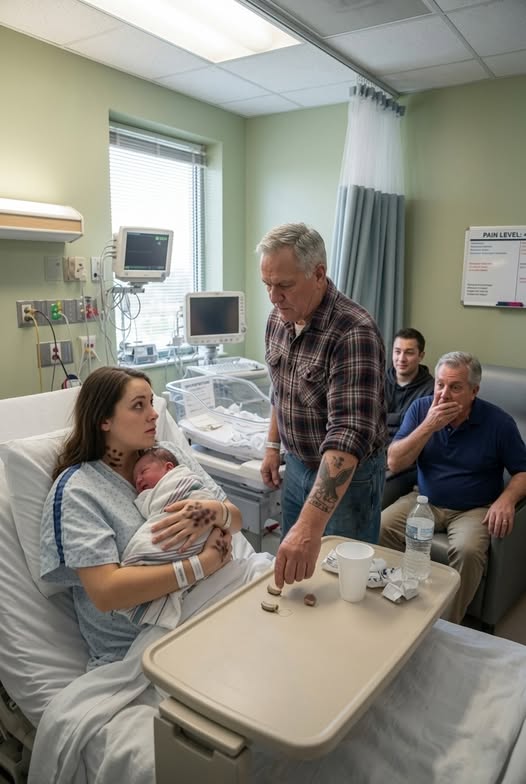
He reached up and pulled the hospital curtain around the bed.
The metal rings scraped along the ceiling track one after another.
It was a small sound.
It felt enormous.
The curtain closed us off from the hallway, from the nurses’ station, from the polite public version of what Derek had done.
Derek’s smile twitched.
“What are you doing?”
Ray did not answer.
He reached up with both hands and removed his hearing aids.
One.
Then the other.
He placed them on the plastic tray beside my water cup.
They clicked against the tray.
That click was the first sound in the room that made Derek’s father react.
He turned his head sharply.
His eyes dropped to Ray’s forearm.
The sleeve of Ray’s flannel had ridden up when he moved.
The faded tattoo showed.
For years, I had seen it as just one more part of him, like the scar near his thumb or the old burn mark on his wrist.
Derek’s father saw something else.
His face collapsed.
The color drained out of him so fast I thought he might faint.
Then he bent over the visitor trash can and vomited.
Derek jumped to his feet.
“Dad?”
His father held up one shaking hand.
He did not look at Derek.
He looked at Ray.
Ray looked back.
“Close your eyes, kiddo,” Ray told me softly.
I did not close them.
Not all the way.
I had spent months being told to look away from what was happening to me.
This time, I needed to see.
Derek’s father wiped his mouth with the back of his hand.
His tailored suit suddenly looked too big for him.
“Ray,” he whispered.
Derek stared at him.
“You know him?”
Ray picked up Lily’s stuffed rabbit and set it on the tray where Derek could see the small black camera pin near its stitched ear.
Derek saw it.
The room changed again.
Power does not always leave with a shout.
Sometimes it slips out of a man’s face when he realizes the thing he thought was private has been watching him the whole time.
“What is that?” Derek asked.
His voice was different.
Thinner.
Ray did not answer him.
He reached into the inside pocket of his flannel and removed a folded paper.
It was the hospital intake addendum.
My signature was at the bottom.
The time stamp read 6:22 a.m.
Visible bruising.
Restricted visitor request.
Advocate contact requested.
Carmen had helped me fill it out between contractions when Derek went downstairs for coffee.
I had been in so much pain I barely remembered signing it.
Ray remembered.
He slid the paper across the tray.
Derek did not touch it.
His father sank into the visitor chair.
Not sat.
Sank.
His knees seemed to quit before the rest of him.
“Don’t,” he whispered.
Ray finally spoke the name.
“Harlan.”
Derek looked from his father to Ray.
“Who the hell is Harlan?”
His father flinched like the name had physical weight.
Ray’s eyes stayed on him.
“You didn’t tell your boy,” Ray said.
It was not a question.
Derek’s father gripped the arms of the chair.
“That was a long time ago.”
“So was the war,” Ray said. “Some men still came home the same kind of coward.”
Derek stepped toward Ray.
It was the wrong thing to do.
He had always used height and money and volume to win rooms.
Ray had none of those things.
He only stood between Derek and my bed like a door that had decided it would never open again.
Derek’s father said, “Sit down.”
Derek stopped.
That was the first time I had ever heard fear in his father’s voice.
A second later, the curtain moved.
Carmen stepped through.
Behind her was a woman in a navy cardigan carrying a folder against her chest.
The domestic violence advocate.
Derek’s mouth opened.
No sound came out.
Carmen looked at me first.
“Do you want these visitors removed?” she asked.
It was a simple sentence.
It was also the first time since Lily’s birth that someone asked what I wanted as if my answer mattered.
My throat burned.
Lily shifted in my arms.
I looked at my daughter.
Then I looked at Derek.
He stared back at me as though he had never considered that I might be allowed to choose.
“Yes,” I said.
The word came out rough.
Small.
It was enough.
Derek lunged for the tray.
Not at me.
At the stuffed rabbit.
Ray moved faster than I had seen him move in years.
He caught Derek’s wrist before Derek touched it.
No punch.
No scene.
Just one old mechanic’s hand closing around a younger man’s wrist until Derek’s face twisted.
“You don’t touch evidence,” Ray said.
Carmen stepped back and hit the call button.
The advocate opened her folder.
Derek’s father covered his face with both hands.
That was when I understood something I had missed for years.
Derek had learned cruelty from his father.
But his father had learned fear somewhere else.
And Ray knew exactly where.
Security arrived two minutes later.
Derek tried to talk over everyone.
He said I was unstable.
He said I had postpartum confusion.
He said Ray had threatened him.
Then the advocate pressed play on the first recording.
Derek’s own voice filled the hospital room.
“The house is mine. The money is mine. The child is mine. You are going to learn obedience.”
Nobody moved.
Even Derek stopped talking.
Recordings sound different when they leave your phone and enter a room full of witnesses.
They become less like memory.
They become weather.
Something everyone has to stand inside.
Carmen’s face hardened.
One security guard looked at my neck and then at Derek’s hands.
The advocate turned one page in her folder.
“There are copies of the relevant materials already secured,” she said. “Medical notes, photographs, financial records, threatening communications, and a preliminary custody coercion concern.”
Derek’s father whispered, “Custody coercion?”
The advocate looked at him.
“Your messages are included.”
He closed his eyes.
Derek turned on him.
“What messages?”
His father said nothing.
That silence told Derek more than words could have.
For the first time, he understood he had not been protected.
He had been documented.
The police officer came after security.
I had expected to feel relief.
Instead, I felt tired in a way that went past my bones.
The officer asked questions.
The advocate stayed beside me.
Carmen took Lily briefly so another nurse could photograph my neck under proper clinical lighting.
I hated that too.
I hated sitting there with my chin lifted while strangers documented the shape of Derek’s hand on my skin.
But evidence is what you gather when nobody believes your bruises until they come with dates.
So I lifted my chin.
Ray stood near the curtain with his hearing aids still on the tray.
He did not put them back in until Derek was outside the room.
Derek’s father was escorted out separately.
Before he left, he looked at Ray once.
“You won’t tell them about Harlan,” he said.
Ray’s mouth barely moved.
“I already did.”
The man’s shoulders dropped.
I did not know what that meant then.
I learned later.
Harlan was not a place.
It was a man.
A commanding officer who had covered up more than one violent mistake decades earlier.
Derek’s father had been part of that circle.
Ray had testified.
Men lost pensions, reputations, and the comfortable stories they had told their families.
Derek’s father had rebuilt himself afterward as a hard, respectable man with money, suits, and rules for everyone else.
But shame has a memory.
So do witnesses.
Ray had been one of those witnesses.
That was why the tattoo broke him.
Not because it was magic.
Because it reminded him of the last time he thought power could bury the truth.
It had not.
It would not this time either.
The first emergency protective order was temporary.
The custody process took longer.
Everything takes longer than people think when the story leaves a hospital room and enters forms, hearings, interviews, and waiting areas with vending machines that only take exact change.
Derek’s family tried to control the narrative.
His mother told relatives I had suffered a breakdown after birth.
The family lawyer sent a letter using words like concern, cooperation, and stability.
My advocate sent back photographs, timestamps, chart notes, and recordings.
The letter writing stopped.
Derek requested supervised visitation and claimed I was alienating him from Lily.
The judge listened.
Then the judge listened to Derek’s recording.
The room went very still at the line about obedience.
I watched the court reporter’s hands keep moving.
That was the strange part.
The rest of us froze, but the record kept being made.
Ray sat behind me in the courtroom wearing his best shirt, the one he only used for funerals and tax appointments.
His hearing aids were in.
His hands rested on his knees.
When I started shaking, he put one palm gently between my shoulder blades.
Not pushing.
Just there.
Derek did not get unsupervised access to Lily.
Not then.
Not after the evaluator reviewed the evidence.
His father was removed from any approved contact list.
The financial records opened a second door.
The bank transfers Derek thought I would never understand were not just selfish.
Some were fraudulent.
Some involved accounts he had told me did not exist.
The family lawyer denied knowledge of the coercive custody email until metadata showed it had come from his office computer at 7:48 p.m. on a Thursday.
People like Derek’s family loved saying mistakes were misunderstandings.
Metadata is not sentimental.
It does not care who has a tailored suit.
Months passed.
Lily grew.
Her hands stopped looking like wrinkled rose petals and started grabbing Ray’s beard every time he held her.
He pretended to complain.
He never once moved her hand away.
Some nights, after she finally slept, I would touch my own throat in the mirror.
The bruises faded.
The memory did not.
For a while, I hated that.
I wanted healing to feel like forgetting.
It did not.
Healing felt more like learning that the memory could stay without owning the whole room.
Ray fixed the lock on my new apartment door.
He installed a chain even though the building already had one.
He checked the windows.
He put a small framed map of the United States on Lily’s nursery wall because he found it at a thrift store and said every kid should know the country is bigger than the people who try to trap her.
That was the closest Ray ever came to poetry.
On Lily’s first birthday, Carmen came by with a small stuffed rabbit that had no camera inside it.
The advocate sent a card.
Ray brought a cake from the supermarket and spelled her name wrong on purpose because he said bakery handwriting needed humility.
For one whole afternoon, nobody raised their voice.
Nobody watched the door.
Nobody measured my words.
Lily smashed frosting into her hair and laughed.
Ray laughed so hard he had to take out one hearing aid and wipe his eyes.
That sound did something to me.
It reminded me that a family could be loud without being dangerous.
Years from now, Lily will ask about the early pictures.
She will notice the hospital bracelet on my wrist.
She may notice the scarf I wore for a few weeks afterward, even indoors.
I will tell her the truth in pieces she can carry.
I will tell her she was loved from the first breath.
I will tell her that some people tried to make her a possession, and other people stood in the doorway and said no.
I will tell her about Uncle Ray kissing her blanket before he did anything else.
I will tell her that strength does not always shout.
Sometimes it closes a curtain.
Sometimes it sets hearing aids on a plastic tray.
Sometimes it lifts its chin while a nurse photographs the proof.
Sometimes silence is not surrender.
Sometimes silence is someone making sure the camera is angled right.
Derek thought he was showing me who the boss of our new family was.
Instead, he showed a room full of witnesses exactly who he was.
And the day Uncle Ray walked into that hospital room, my daughter and I walked out of Derek’s story forever.