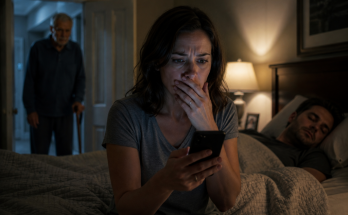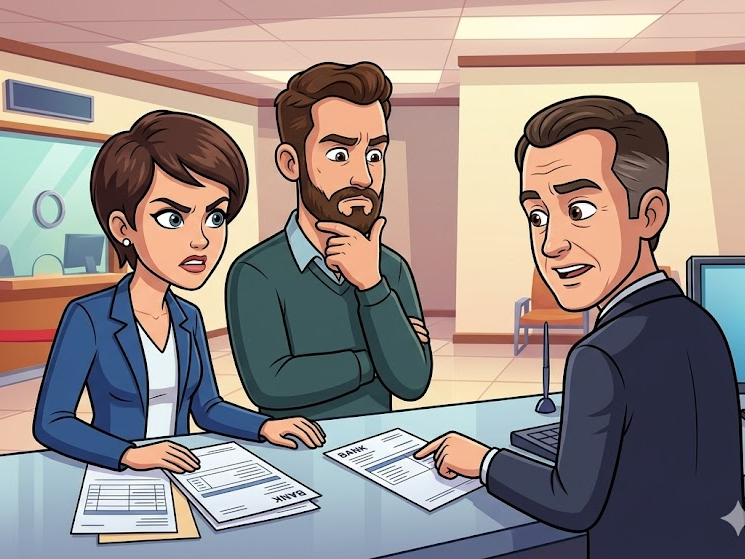
They returned three days early.
They didn’t walk in like a family ashamed or like tired travelers. They walked in the way they always had: making noise, dragging expensive suitcases, complaining about the world as if the world owed them something. Patricia was the first to cross the threshold, wrapped in a cream-colored coat, her lips pursed and her chin held high. Behind her came Jamie, wearing dark sunglasses even though it was already getting dark, and Mauro brought up the rear, dragging two suitcases and talking on the phone to someone at the bank, demanding explanations in a tone that mixed fury and arrogance.
I was sitting in the living room with a cup of tea in my hands, and Veronica was to my right, elegant and calm, with a black portfolio on her lap. Across from us, a notary was waiting. And by the window, looking solemn, stood my company’s forensic accountant.
The scene threw them off for only a second.
Then Patricia reacted.
“What is the meaning of this?” she snapped, dropping her bag onto an armchair as if she still had the right to own the air in the room. “What are these people doing in my house?”
I smiled.
“That’s exactly what I’d like to clarify, Patricia. Because this is not your house.”
Mauro hung up the phone and looked at me with bloodshot eyes.
“What the hell is wrong with you? You put us through a horrifying humiliation. They detained us, froze our hotel, made us pay out of pocket for emergencies, my dad almost passed out from the rage, and you’re just sitting here drinking tea as if you hadn’t done anything.”
“I did exactly what I had to do when someone steals my card and spends hundreds of thousands of dollars without authorization.”
Jamie let out a venomous laugh.
“Oh, please. You’re his wife. It wasn’t theft. It was family support.”
Veronica finally opened her portfolio and set a folder on the table.
“Legally, it was theft,” she said with such impeccable serenity that Jamie lost her smile. “It was also breach of trust, misuse of financial instruments, and, regarding subsequent transactions, potential corporate fraud.”
Mauro blinked.
“Who is this woman?”
“The attorney for the person you have been stealing from for years,” I replied.
Patricia stepped forward, indignant.
“Watch your words, Rebecca. Nobody has stolen anything from you. My son has given you a last name, stability, and social standing.”
I let out a laugh so clear and sharp that it made everyone uncomfortable.
“A last name? Mine opened more doors than his did from day one. Stability? Your son can’t keep a checking account stable. Social standing? Patricia, please. The only thing your family has managed to maintain with discipline is a lie.”
Mauro slammed his suitcase against the floor.
“Enough. We’re going to talk, just you and me.”
“No,” I said, and that word sounded like a deadbolt sliding into place. “No more private conversations where you twist the facts to suit yourself.”
I saw him tense up. Mauro had always hated losing control of the narrative. His favorite trick was to make me doubt my own memory, my own boundaries, my own anger. But that night, he had nowhere to put his hands.
Veronica slid several documents toward him.
“Here are the divorce papers, the request for a financial restraining order, and notice of an internal investigation into the misappropriation of funds from Miller Biotech.”
The color drained from his face.
“What?”
“For eleven months,” Veronica continued, “periodic amounts were transferred from a corporate account to three shell vendors. This morning, we finished linking those payments to a shell company managed by a straw man connected to you.”
Jamie’s eyes went wide. Patricia whipped around to face her son.
“Mauro… what is she talking about?”
He held up both hands, sweat already beading on his forehead.
“That’s absurd. It must be an administrative error. I never…”
The accountant spoke for the first time.
“We have digital signatures, remote authorizations, and correspondence forwarded from your personal email. It is not an error.”
The word correspondence hit exactly where it hurt. I saw the exact moment on his face when he realized he could no longer improvise. This wasn’t a marital spat. It was a documented downfall.
Patricia, however, still didn’t grasp the scale of the fire. She took a step toward me with that old superiority she’d used to crush me for years.
“You are not going to destroy my son over a temper tantrum. You’re a woman. Marriages go through tests. They get fixed. And if you think you own anything, let me remind you that this house is upheld by our family name.”
The notary cleared his throat.
“Forgive me for correcting you, ma’am. The property belongs to the Herrera-Miller Trust. The only living beneficiary is Mrs. Rebecca Miller. Your husband has no ownership stake. Neither do you, nor your children.”
Patricia stared at him as if he were speaking a foreign language.
“That can’t be.”
“It is,” the notary said, dryly. “And there’s more. By virtue of the proceedings initiated, any non-owner resident must vacate the premises by a deadline that expires today, unless expressly authorized by the titleholder.”
Jamie took off her sunglasses.
“Are you kicking us out?”
I looked at her.
“No, Jamie. I am reclaiming my house.”
Patricia let out a strangled gasp and turned toward Mauro.
“Do something.”
But Mauro was no longer the man screaming from the airport. There was something childish and pathetic in the way his gaze darted between the documents, my lawyer, and the door, searching for an exit that didn’t exist.
“Rebecca,” he said, changing his tone with a disgusting speed, “honey, this got out of hand. The trip was a silly thing, yes, but you can’t destroy us over that. We can fix it. I’ll pay you back. I’ll sign whatever you want. Let’s talk calmly.”
“You don’t just owe me for the trip, Mauro.”
I took a sip of tea and set the cup down on the table with total care.
“You owe me three years of tolerated humiliations, of money used behind my back, of meetings where you took credit for contracts I closed, of employees pressured to cover your mistakes, of favors demanded in my name, of bank accounts tampered with, and of letting me live with your mother turned into an executioner inside my own home.”
Patricia exploded.
“I did you the favor of accepting you! You never fit into our family.”
I looked at her with all the calm I had left.
“And I made the mistake of believing I had to be grateful for tolerance where I deserved respect.”
There was a heavy silence. Then Veronica arranged the last folder.
“Furthermore,” she said, “we have filed a preemptive complaint for economic and domestic violence. The private bank, the insurance carrier, and two strategic partners have already been notified that Mr. Mauro Miller has no authority to represent or operate on behalf of Rebecca Miller’s company.”
That was what really triggered him.
“No!” he roared. “You can’t do that. I have a meeting with the Japanese investors tomorrow.”
“Not anymore,” I replied. “I canceled it this morning. And I’ve also canceled your access to the corporate office, the country club, the company car, and the credit line you were using as if it were your inheritance.”
Jamie started to cry. Not out of sadness. Out of rage. Patricia brought a hand to her chest like a soap opera actress offended by life. Mauro, meanwhile, looked at me with naked hatred.
“Did you plan all of this?”
“No. You planned it the day you decided to believe that I would never defend myself.”
Then the doorbell rang.
Nobody was expecting anyone else. Veronica looked at me briefly, and I nodded.
The bailiff walked in, accompanied by two private security guards. He held an additional notice in his hand.
“Mr. Mauro Miller, Mrs. Patricia Salas, and Miss Jamie Miller,” he read in a formal tone, “by instruction of the property owner and based on the granted protective measures, you must vacate the premises immediately, taking only your essential personal belongings. The rest will be subject to inventory.”
“This is an outrage!” Patricia shouted.
“No,” I said, standing up for the first time all night. “An outrage was what you did to me, believing my patience was submission.”
I walked slowly toward Mauro.
I saw him up close, without the social charm, without his rehearsed smiles, without the comfort of believing himself untouchable. Just a man in debt, a coward, held up for years by the talent of a woman he never respected.
“You said if I didn’t reactivate the card, you’d divorce me,” I whispered. “Thank you for giving me the idea.”
He tried to touch my arm. I took a step back.
“Don’t touch me.”
“I’m just talking to you.”
“No. You’re holding me.”
He must have seen something in my face, because he let go immediately.
Good.
Because if he hadn’t, that story would have taken a different path, not the one I wanted to tell.
I walked out with the suitcase to the living room. Adriana made an indignant noise. Ernest shook his head as if I were an investment that turned out defective.
“Do as you please,” he said. “But don’t think about coming back later.”
I left the suitcase by the door. I walked over to the table where the remains of the disaster still lay. Glass, the smell of alcohol, the TV black as a dead eye. I picked up the hammer from the floor.
The three of them recoiled.
I didn’t raise my arm.
I just walked to the kitchen, opened the bag drawer, and tucked it inside a grocery bag. Then I pulled out another folder. The green one. The one I had put together myself when we married with guarantees, manuals, tickets, and invoices for the valuable items that were actually mine or came from my parents.
I went back to the living room and placed it on the bar.
“Everything in here is backed up by invoices or transfers. Everything in here is mine or my parents’. Everything goes with me tomorrow.”
Adriana was on the verge of a heart attack from pure spite.
“You gold digger!”
The phrase made me laugh this time. Truly.
“No, ma’am. A gold digger is Kevin selling other people’s cherries. I would be a gold digger if I stayed here supplying appliances while you call me crazy.”
David ran a hand over his face.
“Are you seriously going to do this over a fight?”
I tucked the folder into my tote bag and grabbed the suitcase.
“No. I’m doing this for my dignity.”
I opened the front door.
Then the doorbell rang.
One long ring.
Persistent.
The four of us stood still.
We all turned toward the door as if the world could still take one more twist and get even worse.
Andrew was the only one to react first.
“I’ll get it.”
He walked toward the entrance with a firm step. We followed him with our eyes. We heard the latch. The door.
And then a woman’s voice.
Old.
Broken.
Familiar.
“I apologize for arriving unannounced… but I was told Rebecca Miller lives here.”
My entire body went cold.
I didn’t recognize the face. I didn’t know her.
The voice.
It was the exact same voice from the old audio clip that had been in my mother’s paperwork. The one that, years ago, on a poorly recorded cassette, said to someone: “Don’t ask any more about the girl, Rose, they’ve already made their life.”
Andrew took a step back.
Standing in the doorway was a very elderly woman, frail, leaning heavily on a cane, her hair dyed an impossible shade of jet black, and a brown manila folder clutched tightly against her chest.
Rebecca saw her.
And the little bit of air she had left vanished.
“No…” she whispered.
The woman locked her eyes onto her.
“Yes, honey. It’s time.”
I felt my heart crawl up into my throat.
“Who is she?” I asked.
The old woman looked at me.
And with a calm that scared me more than any crying ever could, she replied:
“The only person alive who saw your mother hand Charlotte over… and the same person who signed the forged paperwork so the child would end up where she never should have grown up.”