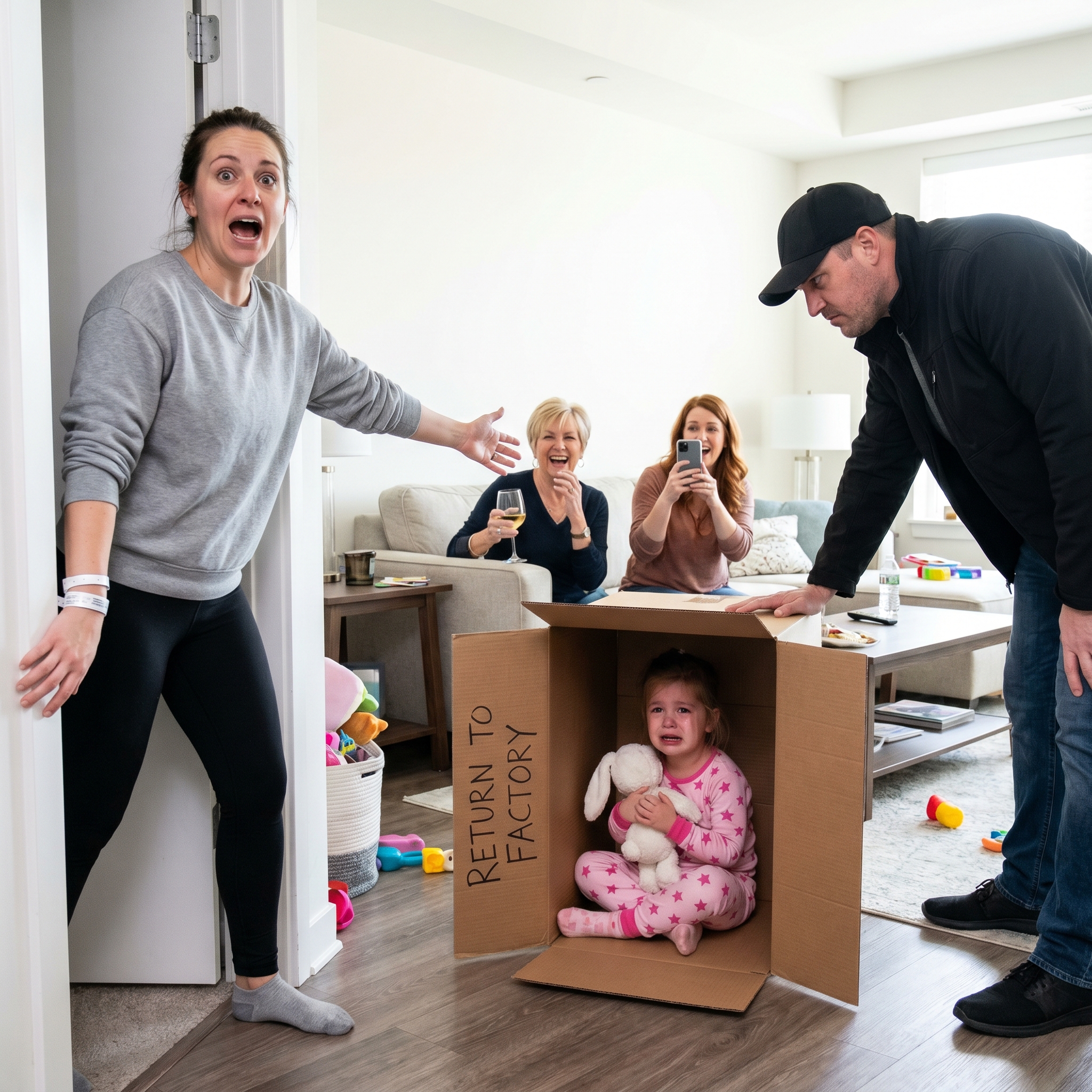
The box was sitting in the middle of my living room like a coffin made for something still breathing.
At first, I thought my eyes were playing tricks on me. I had been discharged from Mercy General that afternoon after eight days of complications from a surgery that should have been routine. I still had hospital tape on my arm, a folder of prescriptions in my bag, and stitches pulling tight under my loose sweatshirt. My mother had promised she and my sister would take good care of Lily, my four-year-old daughter, while I recovered.
I stepped through the front door expecting crayon drawings on the fridge, cartoon music, maybe Lily running toward me with her purple dinosaur tucked under her arm.
Instead, I heard muffled crying.
Then laughter.
My mother, Donna, was on the couch with a glass of wine. My sister, Chelsea, was recording on her phone, one hand pressed over her mouth like she was watching the funniest thing in the world. And beside the box stood a man I had never seen before. He was tall, broad-shouldered, wearing a black jacket and a baseball cap pulled low. He leaned over the box and said in a deep voice, “Bad little girls get sent back. The factory doesn’t want defective kids.”
Lily screamed.
My body went cold.
I crossed the room fast, pain ripping through my abdomen. I tore open the flaps of the box.
My daughter was curled inside with her knees to her chest, her face red and wet, her little hands clutching the stuffed rabbit she slept with every night. Someone had written RETURN TO FACTORY in thick black marker across the side.
When Lily saw me, she clawed at my shirt like she was drowning.
“Mommy, don’t let them take me,” she sobbed. “I’ll be good.”
I held her so tightly she gasped. Then I looked at my mother.
She rolled her eyes. “Oh, calm down. It was a joke. She’s too sensitive.”
Chelsea lowered her phone, still smiling. “You should’ve seen her face. It was priceless.”
The strange man chuckled. “Kid needs toughening up.”
I wanted to scream. I wanted to throw something. I wanted to collapse on the floor and cry with my daughter.
But I didn’t.
Because in that moment, I saw Chelsea’s phone still recording.
I saw the marker. The box. The man’s face. My daughter’s shaking hands.
So I swallowed every sound in my throat and became perfectly calm.
I picked Lily up, walked to the hallway closet, and pulled my coat around her trembling body. Then I turned back to them and said, quietly, “You’re going to wish you had never laughed.”
My mother smirked.
One week later, she stopped smirking.
That night, I did not sleep.
Lily did, eventually, but only after crying herself exhausted against my chest. Every time the apartment pipes creaked or a car door slammed outside, she jerked awake and whispered, “Is the factory man here?”
The factory man.
My four-year-old had a name for her nightmare.
I sat beside her bed until dawn, one hand on her back, the other scrolling through my phone with a kind of icy focus I had never felt before. I replayed the thirty-two seconds of video Chelsea had accidentally sent to our family group chat before deleting it. She must have meant to send it only to her boyfriend, or maybe she thought deleting it would erase the truth.
It didn’t.
I had saved it.
The clip showed everything. The box. My mother laughing. Chelsea whispering, “Wait, wait, do the voice again.” The strange man bending low and telling Lily she was being returned because her mother did not want her anymore.
That was the part that made me shake.
Not from fear.
From rage.
At 7:15 in the morning, I called my attorney. I had used him once before during my divorce from Lily’s father, and he answered like a man who knew bad news never waited for office hours.
I sent him the video.
He was silent for almost a full minute.
Then he said, “Do not contact them. Do not argue. Do not warn them. Take Lily to her pediatrician today. Then a child therapist. Document everything.”
So I did.
The pediatrician examined Lily and noted her distress. The therapist, a woman with gentle eyes and a soft voice, listened while Lily described the box, the factory, and “the man who said Mommy gave me away.” By the end, the therapist’s mouth had tightened into a straight line.
She filed a mandatory report with Child Protective Services.
My lawyer filed an emergency petition to revoke any unsupervised access my mother and sister had to Lily. He also advised me to file a police report because a grown man had entered my home and threatened my child while I was medically incapacitated.
That was when I learned his name.
Chelsea had tagged him in an old Instagram post. Mark Delaney. Her boyfriend’s cousin. Thirty-nine. Two prior arrests for harassment and one restraining order from an ex-girlfriend.
My mother had allowed him into my apartment.
My mother had watched him terrorize my daughter.
By Tuesday, CPS had opened an investigation. By Wednesday, the police had interviewed me, Lily’s therapist, and the neighbor across the hall, Mrs. Alvarez, who told them she had heard Lily screaming, “Please don’t send me away,” through the walls.
By Thursday, my mother started calling.
I did not answer.
Then Chelsea texted.
You’re seriously trying to ruin our lives over a prank?
Then:
Mom is crying. You’re being cruel.
Then:
Delete the video or I swear you’ll regret it.
I screenshotted every message and forwarded them to my lawyer.
Friday afternoon, I received notice that a temporary protective order had been granted. My mother and sister were forbidden from coming near Lily, contacting her, or entering my apartment. Mark was included too.
But the real reckoning came on Sunday.
We were at the county courthouse for the emergency hearing. My mother arrived wearing pearls and a wounded expression, as if she were the victim. Chelsea came in with swollen eyes and a stiff smile. Mark showed up late, smelling like cigarettes, looking annoyed.
They expected me to cry.
Instead, I sat at the table with my lawyer, my daughter’s therapist’s report in a folder, and the video ready to play.
When the judge asked what had happened, my mother sighed dramatically.
“Your Honor,” she said, “this has been blown completely out of proportion.”
Then my lawyer connected the laptop to the courtroom screen.
And the box appeared.
The courtroom changed the moment Lily’s crying filled the speakers.
People shifted in their seats. The clerk looked down. Even the bailiff’s jaw tightened.
On the screen, my daughter’s tiny voice begged, “I don’t want to go back.”
Then Mark’s voice answered, low and cruel, “Too bad. Your mommy signed the papers.”
My mother’s face went pale.
Chelsea covered her mouth.
For once, neither of them laughed.
The judge watched the entire video without interrupting. When it ended, the silence felt heavier than any shouting could have been. Then my lawyer handed over the pediatrician’s notes, the therapist’s report, the screenshots of Chelsea’s threats, and Mrs. Alvarez’s statement.
My mother tried to speak first.
“It was just supposed to scare her a little,” she said.
The judge looked at her over the top of his glasses. “You intentionally frightened a four-year-old child into believing she was being abandoned?”
My mother’s lips trembled. “We didn’t mean any harm.”
The judge turned to Chelsea. “And you recorded it?”
Chelsea began crying. “I didn’t know she’d take it so seriously. Kids forget things.”
“They also remember things,” the judge said.
Then Mark made the mistake of laughing under his breath.
It was small, almost nothing, but everyone heard it.
The judge’s expression hardened. “Sir, you are not this child’s relative, guardian, or caretaker. You entered a home and participated in a threat directed at a minor. You will remain silent unless addressed.”
Mark’s smile vanished.
The temporary order became a long-term protective order. My mother and sister were barred from any contact with Lily for two years, with any future visitation requiring court approval, supervised settings, and proof of counseling. Mark was ordered to stay away from both of us entirely.
But that was only the beginning.
Because CPS forwarded its findings to the police. Because Mark had outstanding issues connected to his prior restraining order. Because Chelsea’s threat to make me “regret it” counted for more than she thought. Because my mother, who worked as an assistant director at a private daycare, had to explain to her employer why she was under investigation for emotional abuse of a child.
By the end of that week, my sister had lost her job at the dental office where she worked. Mark was arrested on an unrelated warrant discovered during the investigation. My mother was placed on leave from the daycare, and parents began pulling their children out after the story spread through town.
That was when the screaming started.
Not Lily’s.
Theirs.
My mother screamed into voicemail after voicemail that I had destroyed her reputation.
Chelsea screamed that I had ruined her life.
Mark screamed at officers outside the courthouse when they told him he was being taken in.
I saved every voicemail and gave those to my lawyer too.
Meanwhile, Lily and I began rebuilding.
It was not quick. Trauma does not disappear because a judge signs paper. For weeks, Lily refused to play with cardboard boxes. She cried when delivery packages arrived. She asked me, again and again, “You didn’t sign papers, right?”
Every time, I held her face in my hands and said, “Never. You are not returnable. You are my daughter forever.”
Slowly, she believed me.
One afternoon in June, a package arrived at our door. Lily froze when she saw it. Then she took my hand and whispered, “Can we open it together?”
Inside was a dollhouse kit I had ordered for her.
We spent the weekend building it. Walls, windows, tiny furniture, a yellow front door.
When we finished, Lily placed her stuffed rabbit inside and smiled.
“It’s not a factory,” she said.
“No,” I told her. “It’s a home.”
That night, after she fell asleep, I carried the old box out to the dumpster behind our building. The words RETURN TO FACTORY were still written across the side.
I looked at them one last time.
Then I crushed the cardboard flat under my foot and threw it away.
My family thought fear would make my daughter small.
They were wrong.
It made me dangerous.