That day the precinct felt quieter than usual — the murmur of radios, the low thump of boots in the hallway, a humming wall of routine that officers live in. So when a small family pushed through the doors, a mother, a father, and a little girl not yet two, heads turned. The child had tearful eyes and a furrowed forehead that somehow made her look older than she was. Her skin still smelled faintly of whatever baby lotion they used. The parents looked thin with worry; the father’s shoulders were tight as if he were holding himself together by force.
“May we see the police uncle?” he asked the receptionist in a voice that was deliberately controlled, like someone who had practiced not breaking.
The receptionist blinked. “I’m sorry, sir, I don’t quite understand… why have you come here and whom would you like to see?”
The man swallowed and straightened, embarrassed. “You see… our daughter has been crying for several days. We can’t calm her down. She keeps saying she wants to talk to a police uncle to confess a crime. She barely eats, cries all the time, and can’t really explain what happened. I’m truly sorry, this is very embarrassing, but… perhaps one of the officers could spare a few minutes for us?”
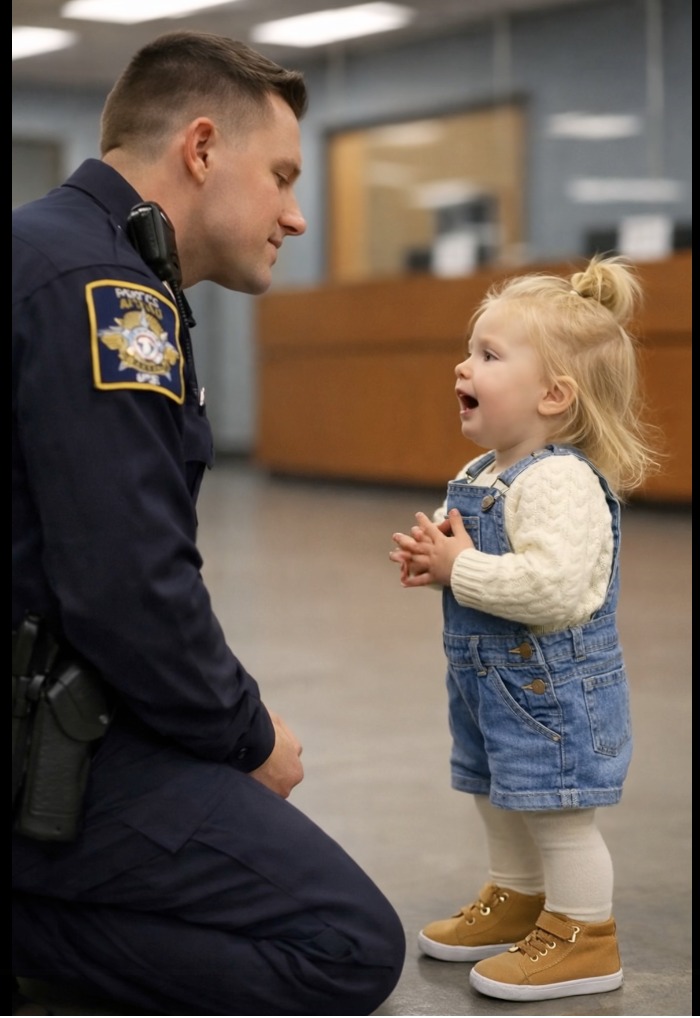
One of the sergeants at a nearby desk overheard and stepped closer. He crouched down so he was at eye level with the little girl, and the change in his posture made something in the room softer. “I have two minutes,” he said gently. “How can I help?”
Relief washed over the father like a small tide. “Thank you so much.” He nudged his daughter forward. “Sweetheart, this is the police uncle. Tell him what you wanted to say.”
She looked up at the sergeant as if weighing him, sniffled, and blurted in a voice that still had the curlicues of toddler speech, “Are you really a police officer?”
“Of course,” he smiled. “See the uniform?”

She nodded solemnly. “I… I committed a crime,” she said, stammering as if naming the crime was a physical thing that scraped her throat.
“Go on,” the sergeant replied calmly, keeping his tone low and even. “I’m a police officer. You can tell me everything.”
“And then will you put me in prison?” she asked in a trembling whisper, wide eyes wells of fear.
“That depends on what you did,” he answered gently, and there was compassion in his voice that made the parents exchange a look — relief, and the barest flicker of hope.
The little girl’s lower lip trembled. She fumbled with the hem of her shirt, then looked directly at her father and mother as if drawing strength from the two people who had brought her here. “I… I made Mommy cry,” she said, words dropping slowly, one by one as if they were heavy stones. “I made a big mistake. I did a bad thing.”
The sergeant’s face softened, already picturing the usual toddler misdemeanors — maybe a broken toy, a necklace pulled off a table, a secret cookie raid. He crouched a little closer. “What happened, sweetheart?”
“She cried in the night,” the girl said, teary, and then, with the brutal honesty of someone whose world is still small and simple, “But I didn’t stop it. I tried to hug her but she didn’t want it. I told her to be brave. I told her it was my fault.”
The officer’s eyebrows rose. The father stiffened for a moment, then sank back as if the words landed where he had feared they might. The mother’s eyes were wet but contained. The sergeant felt a hush settle in, the kind that often comes before a household secret is held up to the light.
“She says Daddy hit her,” the little girl continued, straightening to make sure she was being understood. “I saw Daddy make Mommy fall. I thought if I told someone, he would be angry with me. So I didn’t tell. I wanted to be good.”
The words were simple, a child’s recital of events, but the weight behind them slammed into the room like a physical thing. The sergeant felt his heart jump in a way that made his training catch up to his instincts. He looked at the parents. The father’s jaw went taut and then his face flushed, not with rage but with something like shame and fear. The mother’s face crumpled and she reached for the little girl as if she could hold all of it together by sheer force.
The officer swallowed and kept his voice steady. “How long has this been happening?”
The little girl shrugged, too young to measure months by calendars, but her answer was clear in its smallness: “Sometimes when it’s night. Sometimes when I wake up. I cry and she cries.”
The sergeant’s mind began to organize itself into action: separation, support, safety, documentation. But first he had to deal with the present — the terrified child who believed she had committed a crime by telling the truth. He leaned in and spoke softly, slowly, so the little girl could follow every syllable.

“Telling the truth is not a crime,” he said. “You did the right thing by coming here. No one’s going to put you in prison for telling the truth.”
The child’s shoulders sagged a fraction, like someone who had been holding a heavy stone and finally let it drop. Her parents began to speak at once, the mother apologizing between the sobs and the father trying to explain or deflect, confusion and guilt and relief all tangled together.
Outside the immediate swirl of emotion, the sergeant called for a detective trained in family matters and spoke to dispatch to arrange for a social worker. He made notes, quietly but clearly, then guided the family to a private room where they could speak without waiting room eyes. The whole time, the little girl clutched a ragged stuffed rabbit and nestled against her mother, who now rocked her and murmured apologies and promises.
It was a small body that had done the bravest thing — name an ugliness that adults had been trying to hide or outwait. That courage, naked and unfiltered, was what had left the officer in complete shock: that a child, barely two, could carry more truth than the grownups around her for so long. And that truth, finally spoken, set in motion the long, careful work the police and social services would now have to do to keep a family safe.
The girl couldn’t hold it in any longer, burst into tears, and almost immediately blurted out something that left everyone around her completely shocked. 
 Continuation in the first comment