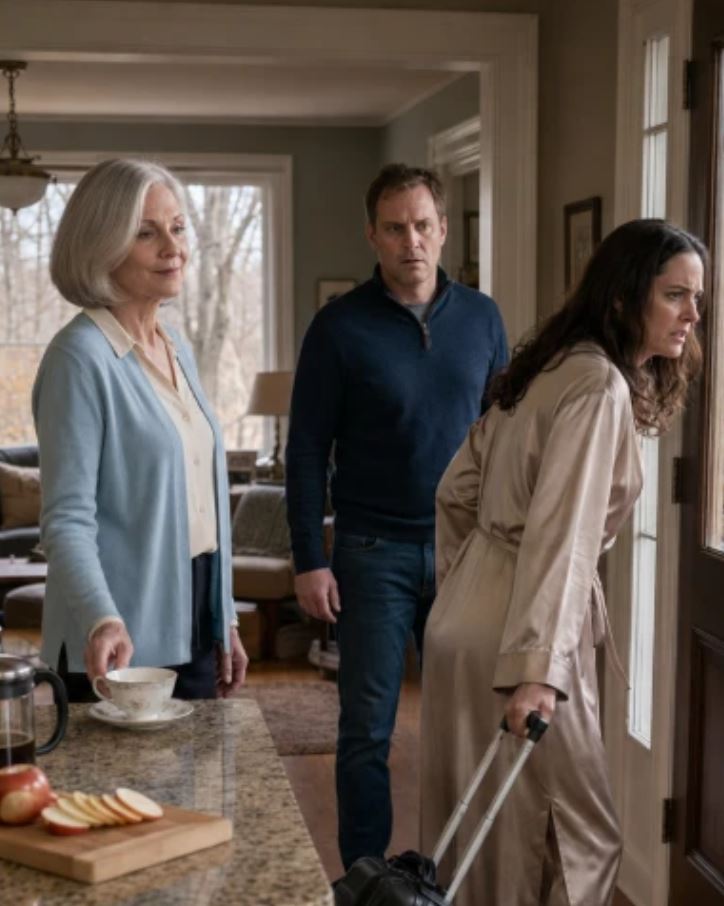
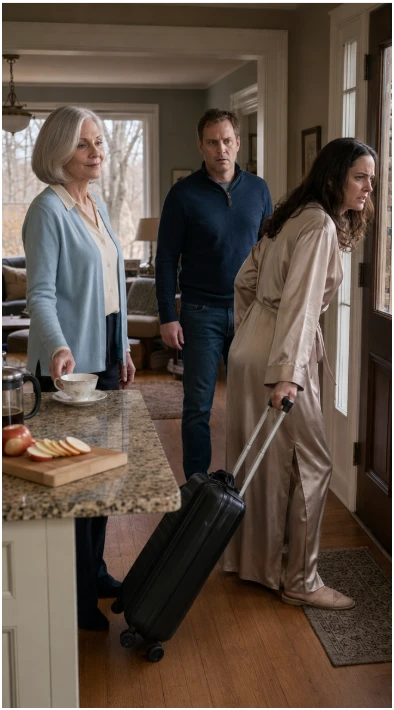
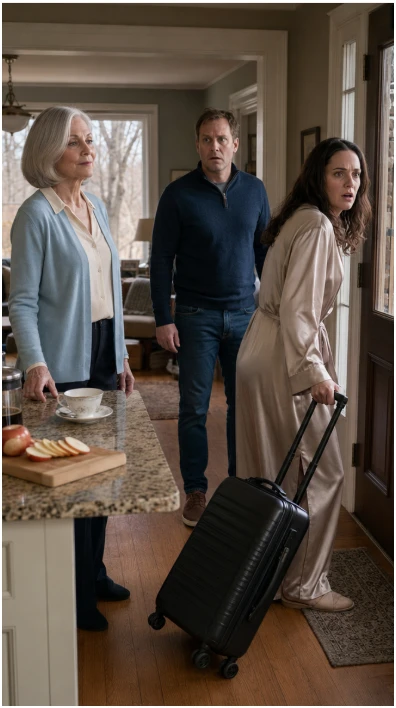
The day my daughter-in-law tried to evict me from my own house, there were coffee grounds on the counter and an apple half-sliced on the cutting board. It was a Tuesday in October, the kind of Ohio morning that smells like wet leaves and cold metal. I was standing at my kitchen window, looking past the back porch my husband had built with his own hands, when Christine padded in wearing a silk robe the color of champagne.
She did not clear her throat or ease into it.
“Maggie, we’ve been talking,” she said as she poured herself a mug from my coffee pot. “We think you’d be more comfortable somewhere with people your own age. There’s a really nice assisted living place on the other side of Denton. We’ll cover everything. You can start packing this week.”
She did not look at me when she said it. She said it to the refrigerator, to the sink, to the air.
I set the knife down, very carefully. “This is my house,” I answered.
That made her turn. The pleasant, reasonable expression slipped just enough that I could see what it had been hiding for years.
“Not for much longer,” she replied softly. “We don’t need your charity anymore, Maggie. We don’t need you.”
In that moment, she did not know that the woman she was trying to push toward a nursing home was holding the one thing money could not simply steamroll: the original winning lottery ticket tied to seventy-five million dollars.
I smiled. It surprised both of us. “Christine,” I asked, “did you actually look at the name on the ticket?”
My name is Margaret Anne Harlo, though almost everyone calls me Maggie. I was sixty-eight years old that October morning, a retired middle-school teacher with a bad knee, a decent pension, and one white clapboard house on Elm Creek Road in Denton, Ohio.
For thirty-one years, that house was the center of my life. My husband, Gerald, and I bought it in 1991 when Daniel was eight and still losing teeth. Gerald swore he’d die before he ever moved again.
He kept that promise in a way neither of us expected.
Gerald built the back porch himself the first summer we lived there, a wide wooden rectangle looking out over two oak saplings we planted the week after closing. He used to sit out there in the evenings with a beer, boots propped on the rail, telling me how big those trees would get by the time we had grandkids.
He never met a single grandchild.
In the spring of 2016, Gerald dropped in our driveway carrying a bag of salt for the water softener. The paramedics were kind. The ER doctor was kind. None of it mattered. The heart attack was quick and complete. One minute I was staring at the red-and-blue wash of lights on the siding; the next I was a widow standing on the very porch he’d built, looking at the outlines of his boot marks fading from the boards.
Those first three years on my own were quiet, but I managed. I had my pension, my garden, my church choir, and my neighbor Ruth, who had lived two doors down for twenty-two years and knew everything worth knowing about everyone on Elm Creek Road. I drove my ten-year-old Honda Civic to Kroger on Tuesdays and to Target when I felt wild. On good days, the silence felt like a soft blanket. On bad days, it felt like the absence of someone breathing beside you in bed.
Lonely is not the same as helpless. I knew that. I told myself that often.
Then, in the fall of 2019, my son called.
I was standing at the stove stirring chili when my phone rang. The display said DANIEL in block letters. I wiped my hands on a dish towel and picked up.
“Hey, Mom.” His voice tried for casual and missed.
“Hey, kid. You sound like you’re about to tell me you dented the car,” I teased.
He laughed, but it came out thin. “I, uh… we’re having a rough couple of months. Work slowed down. The landlord’s talking about raising the rent. Christine’s hours got cut. We’re behind.”
He didn’t ask me for anything. Daniel almost never did. That was his father in him: the stubborn pride that would rather limp than accept a steadying arm.
I didn’t wait for the ask.
“Then come stay here,” I said. “This house is too big for one person anyway. You and Christine can use the guest room until you get back on your feet.”
There was a pause on the line. “Are you sure?”
“Positive,” I said, and I meant it. I missed the noise of a full house. I missed someone else’s shoes by the door.
If I made a mistake that day, it wasn’t loving my son. It was assuming that loving him meant opening my doors to a woman I barely knew.
—
Christine arrived three weeks later in a gray SUV packed with furniture I hadn’t agreed to and opinions I certainly hadn’t invited.
She stepped into my foyer with her chin angled the way some women hold their phones when they’re checking for better lighting. Thirty-four, sharp features, nails done in a color the salon probably called “Winter Steel.” She held out a hand and kissed my cheek in the same movement, already moving past me as if she were inspecting a rental.
“It’s cute,” she said, glancing up at the twelve-foot ceilings in the living room. “Very cozy.”
When someone calls a room with crown molding and original hardwood “cozy,” what they usually mean is “smaller than I deserve.”
I smiled. “It keeps the rain off and the heat in. That’s all I ask from a house.”
Daniel hugged me so hard my ribs popped. “Thanks again, Mom. Just until we catch up.”
“That’s what houses are for,” I told him. “To be used.”
In those first months, it almost felt good. Daniel mowed the lawn, fixed a leaky faucet, and carried laundry baskets up the stairs without being asked. Christine took over cooking a couple nights a week. She was competent in the kitchen and knew it. Her food always tasted one notch better than it needed to, as if every plate came with a scorecard.
We sat together on Sunday evenings in the living room, the three of us, watching whatever streaming show Daniel was into. I would knit, Christine would scroll through her phone, and Daniel would lean his head back on the couch like a boy again.
If there were cracks, they were hairline then. Thin enough to step over.
By the end of year two, I’d learned to see them.
—
I spent thirty-four years teaching middle schoolers who would rather do anything than say what they really felt. You get good at reading the room when you do that for a living. Tone. Posture. Which kids suddenly stop looking you in the eye when you mention homework.
The first thing Christine did without asking was rearrange my kitchen.
I came home from the grocery store one Tuesday to find my pots hung on the opposite wall, the dishes in different cabinets, and the drawer that had held my measuring spoons for twenty years suddenly home to her white silicone spatulas.
“Oh,” she said, when I opened the wrong cabinet for the third time. “I thought this layout made more sense. Everything is closer to the stove now. You’ll see, it’s more efficient.”
“It worked for me before,” I replied lightly.
She shrugged, already halfway up the stairs. “You’ll get used to it.”
Two weeks later, Gerald’s photograph went missing from the mantle.
I found it on a bookshelf in the hallway between the laundry room and the downstairs bathroom, wedged next to a scented candle Christine liked.
“Did you move this?” I asked her.
She didn’t look up from her laptop. “Oh, yeah. I’m working on a more modern vibe for the living room. The frame clashed with the art I’m ordering. He still has a place of honor, don’t worry.”
I put the photo back on the mantle that night after they’d gone to bed. The next week, it migrated to the hallway again.
I moved it back a second time. Eventually, Christine stopped fighting me on that one. I don’t know why. Maybe there was a line even she knew better than to cross.
But the smaller lines, the daily ones—those she stepped over like cracks in the sidewalk.
She complained about my TV shows. About the way I made coffee. About the way I coughed during her conference calls.
“Can you keep it down?” she’d call from the dining room on a Wednesday morning. “My client can hear the blender.”
“Tell your client real people eat breakfast,” I muttered once. Quietly. To the sink.
By year three, she had stopped knocking before walking into my bedroom.
“You scared ten years off my life,” I told her the first time she pushed the door open without warning.
“You should lock it if you want privacy,” she said. “We’re family.”
Family, in her mouth, sounded like a password she thought opened every door.
Daniel stayed gentle and conflict-avoidant through all of it. If I shot him a look across the table when Christine spoke to me as if I were a child, his eyes went soft and apologetic but his mouth stayed shut. “I’ll talk to her,” he would say later, in a tone that said he probably wouldn’t.
By year four, Christine had perfected a particular voice for me—slow, over-enunciated, pitched too high, like she was speaking to someone who’d forgotten how sentences worked.
“Mag-gie,” she’d say, smiling too brightly, “did you remember to take your meds this morning?”
I have never in my life forgotten a pill. I taught seventh-grade science during a swine flu season. You either learn routines or you drown.
So I did what teachers do when confronted with a difficult student: I watched. I took notes in my mind. I did not react to every provocation. I saved my energy for the exam.
I didn’t know yet that the exam would come printed on thin white paper at a gas station on Route 9.
—
The day I bought the lottery tickets, Ruth and I were doing something we almost never did: acting our age badly.
We’d driven out to a farm stand off Route 9 for late tomatoes. On the way back, Ruth swung into the Rutter’s station for gas and coffee.
“You ever buy those?” she asked, nodding toward the bright wall of tickets by the register while stirring sugar into her cup.
“Lotteries?” I shook my head. “I spent thirty-four years teaching probability. I know those odds.”
“Knowing the odds and buying a ticket are two different muscles,” she said. “Come on, Maggie. Two bucks. Live dangerously.”
I snorted but stepped toward the display. Tiny colored squares promising impossible things. I picked the multi-state jackpot card I’d heard them talk about on the news.
“Two, please,” I told the clerk. My hand surprised me, pulling my debit card out of my wallet before I could change my mind.
The clerk slid me two printed slips with seven numbers each. They felt like nothing at all—no heavier than receipt paper.
Ruth laughed when we got back to the car. “Look at you,” she said. “Rebel.”
“Middle-school teachers get wild in retirement,” I said. “Hide your fine china. We spend two dollars at gas stations.”
At home that evening, I stuck one ticket in a plain white envelope and tucked it into the bottom drawer of Gerald’s old roll-top desk, the one he’d inherited from his father. I had no idea why. Habit, maybe. A lifetime of putting important things in that drawer.
The second ticket I left on the counter without thinking.
Daniel came into the kitchen a little later, still in his work boots, scrolling his phone.
“What’s that?” he asked, nodding at the slip of paper.
“Lottery ticket,” I said. “Ruth made me buy two. Take it if you want.”
He picked it up with two fingers the way you’d pick up a gum wrapper. “Thanks, Mom.” He tucked it into his wallet without really looking.
I had no way of knowing I’d just handed him a piece of paper that would soon be worth seventy-five million dollars.
Or that the other ticket—the one in the envelope in Gerald’s drawer—would turn out to be worth exactly the same.
—
For three weeks, I forgot the tickets existed.
Life went on: laundry, grocery lists, Christine’s endless zoom calls, the way the oak trees out back had started to go from green to gold.
I found out about the winning numbers the way most people do: by accident.
It was a Sunday afternoon. Christine burst into the kitchen so fast the back door banged against the stopper.
“Daniel!” she shouted. “Where’s your wallet?”
He stumbled in from the garage, grease on his hands. “What? Why?”
“The ticket,” she said, breathless, eyes wide in a way I’d never seen before. “The one your mom gave you. Did you check it? The drawing was last night. They just announced the numbers. I swear, Daniel, I saw those numbers somewhere—”
My heart did a strange, slow flip in my chest.
“It’s in my jeans,” he said, bolting upstairs.
I stood by the sink, dish towel in my hands, watching as if this were a television show instead of my life.
He came back down with a crumpled slip of paper and his phone. He read the numbers out loud. Six matched. Then the bonus ball.
Christine screamed. It was not a pleasant sound. It was raw and high and edged with something that felt like hunger.
“Seventy-five million,” she gasped, grabbing his arm with both hands. “Daniel, do you understand? That’s the jackpot. That’s the whole thing.”
He stared at the ticket like it might bite him. Then he looked at me.
“Mom,” he whispered. “Mom.”
I walked over, slow because of my knee, and looked at the numbers. The ink was still slightly smudged from wherever he’d left it. The ticket had a faint coffee stain in one corner. Nothing about it looked like seventy-five million dollars.
“Looks like you won,” I said, and patted his arm.
Christine was already talking about lawyers before the shock finished washing over his face.
“We need an attorney,” she said. “A big-firm one. And a financial adviser. We have to be smart about this. Taxes. Investments. Trusts. We can’t just walk in and hand it over.”
Daniel nodded, dazed. “Yeah. Yeah, okay.”
I went back to the sink. My hands moved on their own—rinse, stack, rinse. Over the next week, the house filled with phone calls and new voices. Daniel’s old college friend recommended a firm in Cleveland; Christine found a financial planner on the internet who specialized in “high net-worth individuals.”
“Us,” she kept saying into the phone. “We’re high net-worth now.”
She floated through my living room measuring walls with her eyes as she talked about new furniture, new paint, maybe “opening up the space” with some demo.
She started saying things like, “When we’re out of Elm Creek” and “Our next house.”
Our. Not once did she include me in that pronoun.
The weirdest part was how quickly I became an extra in the story of my own home.
When the financial adviser came, Christine greeted him at the door, led him past me without introductions, and took him straight to the dining room table, where she’d set up binders and spreadsheets.
“Daniel’s mother,” she said vaguely over her shoulder when he glanced my way. “She’s been letting us stay here.”
Letting.
The word lodged in my throat like a fishbone.
That night, I sat on the back porch Gerald built and listened to them through the open windows, talking about condos in Chicago, houses on the lake, private schools for hypothetical children.
Not once did I hear my name.
Seventy-five million dollars had dropped into our lives like a meteor, and the first thing it had burned away was the illusion that we were all on the same side.
—
The Tuesday Christine tried to evict me, I had been living in that new atmosphere for about a week. The air felt thinner every day.
Her words—assisted living, we don’t need your charity—hit with the cold precision of a scalpel.
I did not shout. I did not throw her out. I did what years in the classroom had trained me to do in a crisis.
I thought.
After she left the kitchen, heels ticking down the hallway, I stood at the counter and looked around my own house like it was a crime scene.
The deed was in my name. I knew that as surely as I knew the layout of every drawer. Gerald and I had bought the place together, and when he died, everything passed to me. I had never signed a quitclaim deed. There had been no reverse mortgage, no complicated paperwork with fine print.
On paper, this was still my address and my asset.
But paper and power are two different things when seventy-five million dollars is involved.
I was sixty-eight. I had an arrhythmia controlled by medication, a car with a slow leak in one tire, and a body that took the stairs more slowly than it used to. They had youth, cash on deck, and attorneys on retainer.
They could challenge my mental capacity.
They could hire people to testify that I was forgetful, that I mislaid objects, that I sometimes talked to Gerald’s photograph when I washed dishes.
They could make my life inside my own walls so unbearable that leaving would feel like my idea.
For a few minutes, fear roared loud enough to drown out everything else.
Then another thought slipped in like a student raising their hand in the back row.
The ticket.
Not Daniel’s ticket, curled somewhere in his lawyer’s file. The other one. The one I had slid into an envelope and tucked into the bottom drawer of the roll-top.
I wiped my hands, walked down the hallway past the photographs, and went into my bedroom. Gerald’s desk sat in the corner where it always had, its curved top closed like a turtle shell.
My hands shook as I opened the roll-top and pulled out the bottom left drawer.
The envelope was exactly where I’d left it, behind a bundle of old bank statements and the instruction manual for a microwave we no longer owned.
I slid the lottery ticket out.
Same draw date. Same game. Same numbers.
Two tickets, purchased back-to-back on Route 9 with my card, bearing seven digits that added up to seventy-five million dollars.
I backed up and sat on the edge of Gerald’s side of the bed, ticket in one hand, envelope in the other.
“Okay,” I whispered to the empty room. “Okay.”
I did something then that I almost never do.
I asked for help.
—
Ruth answered on the second ring.
“Maggie? You never call before noon. What’s wrong?”
“Can you come over?” I said. My voice sounded strangely calm in my own ears. “Christine just tried to relocate me like a piece of old furniture. And I think I might own seventy-five million dollars.”
There was a beat of silence. Then, “I’m on my way.”
Ten minutes later, her old Ford truck rattled into my driveway. Ruth came in without knocking, as she always did, and I met her at the kitchen table with the ticket and the gas station receipt.
“Explain,” she said.
I did, from Route 9 to the silk robe.
When I finished, she reached for the ticket carefully, like it was made of glass, and read the numbers aloud.
“Well, hell,” she said finally. “You really know how to pick your moments, Maggie.”
I almost laughed. It came out like a cough.
“Is it even legal?” I asked. “Can there be two winning tickets?”
“It’s the same numbers on the same draw,” she said. “That’s how the game works. They just don’t expect anyone to be sentimental and reckless enough to buy the same one twice.”
She pulled her reading glasses down her nose and squinted at the receipt. “Your card, your name, two purchases, one transaction number. You didn’t sign either ticket?”
“No.”
“Did Daniel?”
“I don’t think so. He stuffed it in his wallet like a coffee punch card.”
Ruth blew out a breath. “Okay. My nephew David does family and property law down in Columbus. He’s good and he’s mean in the right ways. We’ll talk to him.”
“I don’t want to hurt Daniel,” I said quickly. The words rushed out before I could stop them. “He’s my son. If they’d just… if they hadn’t—”
“Thrown you out of your own kitchen?” Ruth finished. “Maggie, they already decided what they’re willing to do to you. You’re just deciding what you’re willing to do to them in return. There’s a difference.”
She put her hand over mine. Her skin was rough from years of gardening. “You are not stealing from your son. You are protecting yourself from a woman who thinks seventy-five million dollars gives her eminent domain over your life.”
I swallowed. The ticket crackled between my fingers.
“Call David,” she said. “Today. Before some fancy lawyer in Cleveland files paperwork you can’t unring.”
—
Two days later, I drove to Columbus.
I told Christine I was visiting an old colleague from my teaching days. It wasn’t exactly a lie. It just wasn’t the whole truth. She barely glanced up from her laptop.
“That’s nice,” she said. “Don’t overdo it. The roads can be tricky this time of year.”
Daniel was in the garage tinkering with something under the hood of his truck. He wiped his hands on a rag and straightened when he saw me.
“Going somewhere?” he asked.
“Just into the city,” I said. “Ruth’s got a friend who needs help with her classroom. I promised some old posters.”
He smiled. “Only you would still be hauling bulletin board stuff around in retirement.”
I smiled back, leaned up, and kissed his cheek. “Lock the door behind me,” I said.
The drive into Columbus along Route 33 took an hour and change. I listened to public radio talk about migratory birds and let their calm voices hold up my worry like a hammock.
David Callaway’s office sat on the fourth floor of a building near the Short North. Not fancy, not shabby. The reception area smelled faintly of coffee and copier toner.
David was thirty-nine, with Ruth’s eyes and a tie that looked like his wife had picked it out. He shook my hand, offered me a seat, and listened without interrupting as I laid out the entire story.
When I was done, he picked up the ticket and the Rutter’s receipt and studied them the way Gerald used to study home repair manuals.
“You purchased these together?” he asked.
“Yes.”
“With your debit card?”
“Yes.”
“You didn’t sign either ticket?”
“No.”
“Has your son signed his?”
“I doubt it. He’s been too busy hyperventilating into the phone with advisers.”
David nodded slowly. “Has any official claim been filed with the Ohio Lottery Commission?”
“As far as I know, not yet. Their attorney is still talking about tax strategies and lump sum versus annuity.”
He tapped his pen against the desk. “All right. Here’s the thing, Mrs. Harlo. In Ohio, unsigned lottery tickets are bearer instruments. That means whoever holds the ticket can, in theory, claim the prize. But in disputes like this, the commission has to look at purchase evidence and intent.”
“Intent,” I repeated. “I didn’t intend anything. I was buying tomatoes.”
He smiled faintly. “You intended to buy two chances at a jackpot. You then gave one physical ticket to your son as a casual gift. You did not sign away the beneficial interest in any potential prize because, at that moment, the prize did not exist. There’s an argument to be made there.”
“An argument strong enough to keep me in my house?”
He leaned back in his chair.
“Possibly,” he said. “But we have to move fast. Once Daniel’s ticket is filed and the prize is processed, the money will be in play. Trying to claw back anything from that point would be an uphill slog.”
“How fast is ‘fast’?”
He checked something on his computer. “Their attorney filed a preliminary intent-to-claim notice forty-eight hours ago. That’s standard for a jackpot of seventy-five million. They’ll probably submit the physical ticket in the next ten to fourteen days.”
“Ten days,” I repeated.
“For our purposes, think of it as less,” he said. “We need to notify the commission immediately that there’s a competing ownership claim. That will at least put a hold on disbursement until they sort it out.”
“And Daniel will find out,” I said.
“Yes.”
“Christine will, too.”
He met my eyes. “Are you prepared for that?”
I thought of Christine standing in my kitchen telling me there were nice facilities on the other side of town. I thought of her voice when she said we don’t need you.
“Yes,” I said. “I am.”
David got to work.
That afternoon, we drafted an affidavit stating that I had purchased both tickets on Route 9 with my card, that I had retained one and casually handed the other to my son with no discussion of prize rights, that I had discovered the duplicate only after my daughter-in-law attempted to remove me from my home.
He took copies of my bank statement showing the debit charge, the Rutter’s receipt, and the ticket itself. He prepared a letter to the Ohio Lottery Commission’s legal department, formally requesting that no prize be released pending resolution of the ownership dispute.
“This won’t automatically give you the money,” he said, as I signed the last document. “But it plants a flag. It tells the commission there’s a second story they have to take seriously before they hand over seventy-five million dollars to anyone.”
“Flags are good,” I said. “I used to grade papers in red pen. I appreciate a visible mark.”
He smiled. “Then let’s mark this.”
By four o’clock, the notice was submitted electronically and a certified letter was on its way to Columbus’s state office building.
David walked me to the elevator.
“They’re going to be furious,” he warned.
“I assumed,” I said.
“If anything escalates at home—if they threaten you, if you feel unsafe—call me. And then call 911. Don’t try to handle that part alone.”
I nodded, hugged my purse to my chest, and drove home under a low gray sky that matched my nerves.
I had planted my flag. Now I had to see who would try to pull it up.
—
They didn’t even wait a full day.
When I turned into the driveway on Elm Creek Road, every light in the house was on. I hung my coat on the hook Gerald installed in 1994 and hadn’t yet taken my shoes off when Christine appeared at the end of the hallway with her phone in her hand.
“We need to talk,” she said.
Her voice was very calm. That always meant the opposite.
Daniel hovered behind her, hands in his pockets, shoulders tight.
I walked into the living room and sat in Gerald’s armchair—the dark green one Christine had tried twice to replace with something “more modern.” I put my hands on the worn arms and waited.
Christine took the couch. Daniel stayed by the window.
“Our attorney called,” she began. “Apparently, the lottery commission received some sort of notice this afternoon claiming a competing ownership interest in Daniel’s ticket. In your name.”
“Yes,” I said.
The word landed in the room like a dropped stone.
“Maggie,” Daniel said, his voice strained. “What are you doing? That ticket was a gift. You handed it to me. You told me to take it.”
“I handed you a two-dollar piece of paper,” I replied. “I did not sign away whatever that paper might someday be worth. At the time, it was worth exactly what it cost.”
“That’s not how gifts work,” Christine snapped.
“It is, however, how bearer instruments and ownership evidence work under Ohio law,” I said. David had given me that sentence. I had practiced it on the drive home.
Christine’s jaw tightened. “This is a stunt. You’re trying to take money that belongs to us because you’re upset about a conversation you misunderstood.”
“I understood it very clearly,” I said quietly. “You told me to pack my things and go live with strangers because you don’t need my help anymore. I took you at your word.”
“You’re going to blow up our lives over this?” she demanded. “Over a misunderstanding?”
“Christine,” I said, “you already blew up mine.”
She leaned forward, lowering her voice even though no one else was in the house.
“You have no idea what you’re starting,” she said. “We have resources now. We can keep this tied up in court until you’re ninety. We can bring in doctors, evaluators, people who will ask very pointed questions about your memory. At your age, that will interest a judge. Or”—she softened her tone artificially—“we can be civilized. You withdraw the notice, we set up a generous monthly allowance, and you stay here as long as you want. Comfortable. Taken care of.”
An allowance.
As if I were a dependent they’d decided to keep.
As if the house I’d paid off one mortgage payment at a time were a perk of their new lifestyle.
“No,” I said.
She blinked. “No?”
“I am not signing away a legal claim in exchange for the privilege of being tolerated in my own kitchen,” I said. “I will not accept an allowance from the woman who told me to go pick out a nursing home brochure.”
Daniel stepped away from the window.
“Mom, please,” he said. “This is our family. It’s not worth… all of this.”
“You stood there two days ago,” I reminded him, “while your wife informed me that my presence was no longer required. You didn’t say a word.”
His shoulders sagged.
“I’m not doing this because I want the money more than I want you,” I said. “I’m doing this because you two only started counting my existence when I turned out to be standing between you and seventy-five million dollars. That’s not a feeling a person forgets.”
Christine’s face went cold.
“You’ll regret this,” she said, and stood so fast the couch cushion breathed.
She left the room. Daniel lingered, looking ten years older than he had the week before.
“I’m sorry,” he whispered.
“I know,” I said. “Good night, Daniel.”
He went upstairs.
I sat alone in Gerald’s chair, listening to the house creak, and let myself shake.
Fear is sneaky at my age. It doesn’t crash in. It seeps. It whispers about doctors and forms and courtrooms where strangers decide if you’re still fully yourself.
I thought about all of that. I also thought about the ticket in the envelope in my dresser drawer and the back porch Gerald built, bleached now at the edges from so many summers.
They wanted me to surrender in exchange for comfort.
Comfort is not the same as safety.
I chose safety.
—
The next three days were a study in silence and strategy.
I stayed polite and distant. Christine and Daniel stayed out of my way except for the bare minimum of household interaction.
On the fourth morning, Christine came downstairs early and made me breakfast.
That was how I knew the strategy had changed.
She set a plate of scrambled eggs and toast in front of me, poured coffee into my mug, and sat across from me as if we did this every day.
“I owe you an apology,” she said. Her voice was softer, the edges sanded down. She wore a gray cardigan instead of silk.
“For what?” I asked.
“For the other morning.” She folded her hands. “I was stressed. I said things in a way I shouldn’t have. We’ve all been on edge. It’s a lot to process.”
“That it is,” I agreed, tasting the eggs. They were perfectly cooked. Christine rarely did anything without competence.
“I’ve been thinking,” she went on. “We don’t have to let this tear us apart. We’re family. The money can help all of us. We could buy you a beautiful place of your own. Somewhere warm if you want. Florida, maybe. Full ownership in your name. No strings. You’d have independence. We’d have some breathing room. And we’d all stay out of court.”
There it was: the Florida house.
Not the worst offer in the world, if you ignored the part where accepting it meant agreeing that they owned the right to offer it at all.
“And the notice with the commission?” I asked.
She hesitated just a fraction of a second. “If we’re able to settle this inside the family, I think it would be best to withdraw it. Lawyers complicate things. They make people take sides.”
I sipped my coffee.
“I’ll think about it,” I said.
I did think about it.
For forty-five honest seconds, standing in front of my closet choosing a sweater, I pictured myself in a little stucco bungalow in Florida with bougainvillea climbing the fence. I imagined morning walks on the beach and afternoons reading in a screened-in porch, no more silent wars over kitchen cabinets.
Then I saw the back porch my husband built, the oak trees he planted out back, the hook by the door he installed for my keys. I saw the kitchen where I had taught my son to flip pancakes with a plastic spatula.
The Florida house would be nice.
It would also be proof that if someone throws enough money at a problem, they get to rewrite the story of who gave what to whom.
I called Ruth.
“She made you eggs?” Ruth said when I finished.
“Very good eggs,” I admitted.
“And dangled a house in Florida.”
“Yes.”
“What did David say?”
“I haven’t told him yet. I called you first.”
“Call him second,” she said. “Then come over for dinner. I’ve got pot roast and someone I want you to meet.”
The someone turned out to be Ruth’s friend Carol, a retired Methodist pastor the town still called Pastor Fenner even though she technically wasn’t on staff anymore.
“I’ve sat with more families than I can count while they tore each other apart over money,” Carol said over mashed potatoes. “The only consistent thing is that everyone thinks they’re the reasonable one.”
“Am I being reasonable?” I asked.
“You’re being clear,” she said. “That matters more.”
That night, after I came home, I called David.
“Hold the course,” he said when I described the Florida house. “If they’re offering real assets already, it means they know they’re not walking into this with a clean hand. Any private settlement without documentation is going to favor them. Don’t sign anything. Don’t agree to anything. If you change your mind later, we can always open that door. If you close this one now, it’s gone.”
“Got it,” I said.
“And Maggie?” he added. “They’re not done. When charm doesn’t work, people like that escalate. Expect it.”
I thanked him, turned off my light, and lay awake listening to the old house settle.
The back porch creaked in the wind. The oak branches brushed the siding like fingers.
Gerald used to say that houses remember who they belong to.
I hoped he was right.
—
They came at ten on a Saturday morning, together, with the solemnity of a parent-teacher conference.
Daniel knocked on my bedroom door for once, instead of just calling down the hall.
“Mom? Can you come to the living room? We want to talk.”
Christine sat on the couch in that gray cardigan again, hands folded. Daniel stood beside her. They had clearly rehearsed.
“We wanted to have an honest conversation,” Daniel began. “Just us. No lawyers.”
“Okay,” I said, settling into Gerald’s armchair.
He took a breath. “I know things have been… tense. I know I haven’t always stepped in when I should have. I’m sorry for that. I never wanted you to feel disrespected in your own home.”
Some part of me, the part that remembered dandelions clutched in a grubby fist, softened. Another part stayed exactly where it was.
“Thank you,” I said.
Christine leaned forward.
“Look, Maggie,” she said, “none of us wants to spend the next year fighting. If this goes any further, there will be investigators, hearings, public records. Neighbors will talk. The papers might even pick it up if they’re bored enough. Do you really want to be the woman in the news trying to take a seventy-five-million-dollar jackpot away from her own son?”
There it was: the threat of shame.
“I want to be the woman who isn’t sent to a facility against her will because someone else hit the Powerball,” I said.
“That’s not what this is,” she said quickly. “We just think you’d be safer—”
“You said,” I interrupted, “that you don’t need me. You said you don’t need my charity. You said I should pack a bag. Which version am I supposed to believe? The one where I’m indispensable family or the one where I’m a burden you’ve outgrown?”
She flushed.
“That’s not fair,” Daniel said quietly.
“Fair is an interesting word to bring into a conversation about seventy-five million dollars,” I replied. “Daniel, did you or did you not stand in the kitchen while your wife told me to leave?”
He winced. “I didn’t stop her,” he said. “I’m not proud of that.”
“I’m not punishing you,” I said. “I’m protecting myself. It took seventy-five million dollars for me to realize just how optional my presence was in my own home. That’s a hard bell to unring.”
Christine’s calm cracked.
“You are making a mistake,” she said, her voice low and tight. “You think that little lawyer of yours can stand up to the team we can hire now? They will go through every inch of your life. Every doctor’s note. Every little quirk. Every time you misplace your keys. Do you really want strangers deciding whether you’re competent enough to manage seventy-five million dollars?”
She leaned back. “We are trying to give you a dignified way out. We are willing to do that until next Saturday. After that, that offer disappears.”
I let the silence stretch.
“Thank you for letting me know,” I said finally.
She stood and walked out, heels clipping hard against the hardwood.
Daniel lingered.
“She doesn’t quit,” he said quietly. “When Christine sets her mind on something, she goes all the way.”
“So do I,” I said.
He looked at me for a long second, something like reluctant respect in his eyes, then followed her upstairs.
My hands shook when they were gone. I let them.
Then I picked up my phone and texted David.
“They gave me a deadline,” I wrote. “Next Saturday.”
“Good,” he replied. “That means they’re worried about the commission’s timeline. We’re exactly where we need to be.”
—
The Ohio Lottery Commission scheduled the dispute mediation for three weeks later in Columbus.
It wasn’t a courtroom. It was a beige conference room on the seventh floor of a state office building, the kind of space where budgets were argued and policy memos went to die. Fluorescent lights hummed overhead. A long laminate table sat in the middle, lined with plastic water bottles and tiny notepads no one would use.
The mediator was a man named Gregory Sims with bifocals and the weary patience of someone who had seen every flavor of family drama money could buy.
Daniel and Christine arrived with two attorneys in tailored suits that probably cost more than my car. Christine wore a charcoal blazer and the expression of someone walking into a negotiation she expected to win. Daniel looked mostly at the floor.
David sat beside me in his sensible off-the-rack suit, flipping through a neatly organized binder.
Gregory explained the process: each side would present its position, the commission’s regulations would be reviewed, and then they would decide whether to process the claim, hold the money, or punt everything into a full-blown civil trial.
Christine’s attorney—Whitfield, from Cleveland—went first.
He was very smooth. He described the ticket as a gift, given freely and without reservation, part of the ordinary back-and-forth of family generosity. He cited case law about informal gifts of personal property and used phrases like “opportunistic interference” and “bad-faith attempt to rescind a completed gift.”
He painted me as a grieving widow manipulated by resentment and outside influences.
I sat still and let him.
When he finished, Gregory turned to David.
David didn’t try to out-slick him. He simply laid three documents on the table: the debit card receipt from Rutter’s showing two tickets purchased in one transaction, my bank statement with the matching charge, and a printed copy of the commission’s regulation about disputed bearer instruments.
“Mrs. Harlo purchased both tickets with her own funds,” he said. “There is no signed transfer, no contemporaneous writing, no witness to any discussion of prize rights. She handed her son a two-dollar piece of paper. At that moment, the prize did not exist. Under the commission’s own rules, when there is a dispute about entitlement, you look at purchase evidence and intent.”
Whitfield objected, arguing that intent could be inferred from the act of handing over the ticket.
Gregory steepled his fingers. “Let’s ask,” he said. “Mrs. Harlo, in your own words, what did you mean to give your son that night?”
Every head at the table turned toward me.
I thought about trying to sound like a lawyer. Then I decided against it.
“I bought two tickets because my neighbor dared me,” I said. “I kept one and gave one away, the same way I might hand someone a birthday card or a free sample. I did not think about what would happen if it won because at that point, it was worth exactly two dollars. If I had known it would become seventy-five million, we would be having a very different conversation.”
A corner of Gregory’s mouth twitched.
Whitfield started to speak, but Christine cut him off.
“This is ridiculous,” she burst out. The smooth veneer she’d worn into the room was cracking. “She’s rewriting history because she’s mad that we suggested assisted living. She gave us that ticket. He won. End of story. This is just an old woman’s spite dressed up as a legal argument, and you all know it.”
The room went very, very quiet.
“Ms. Harlo,” Gregory said mildly, “I’d ask that you let your counsel speak for you.”
But he had heard what he needed to hear. So had everyone else.
Within a week, the commission issued its decision.
—
I was in the backyard cutting down the dead coneflower stalks when my phone rang.
“This is David,” I answered, since he was saved in my phone as RUTH’S NEPHEW until that moment.
“They ruled in your favor,” he said without preamble. “The commission found that your purchase evidence is sufficient and that there was no clear transfer of prize rights. They’re refusing to process Daniel’s claim. If anyone wants that money, it has to be through the ticket in your possession.”
The pruning shears slipped a little in my hand.
“What happens now?” I asked.
“Now you bring your ticket in and submit your own claim. Once that process is underway, Daniel and Christine will have the option of filing a civil challenge, but they’ll be starting from behind. And given Ms. Harlo’s remarks on the record, any attorney with sense is going to think twice about that.”
“On the record,” I repeated.
“They transcribe everything,” he said. “Her ‘old woman’s spite’ line is part of the file now. Juries don’t love that.”
I stared at the small pile of dead stems at my feet.
“All right,” I said. “Tell me what to do.”
—
I drove to Columbus again that Thursday, ticket in my wallet, hands sweating on the steering wheel.
The Ohio Lottery Commission’s claims office was tucked behind security doors and glass partitions. They took my ID, my Social Security number, the ticket, and several forms that basically amounted to: We are about to give you an amount of money most human brains cannot conceptualize. Please don’t lie to us.
I chose the lump sum with David and the financial adviser David recommended standing by my shoulder. After federal and state taxes, it would be about thirty-eight million dollars.
More than enough.
It took eleven days for the verification process.
For eleven days, I lived inside a pressurized bubble with my son and his wife.
We passed each other in the hallway like polite strangers. We did not eat together. Christine did not speak to me at all. Daniel knocked on my door one evening and asked if I needed anything from the store.
“No, thank you,” I said. “I’m fine.”
The air hummed with potential energy, like the moment before a summer storm when even the birds go quiet.
When the official letter arrived, I sat at the kitchen table with a pad of paper and a pen and wrote out the words I needed to say.
Then I called David.
“I want them out of my house,” I said. “Not tomorrow, not in a rage. Properly.”
“We’ll do it by the book,” he said.
We drafted a formal notice giving Daniel and Christine sixty days to vacate the property at Elm Creek Road. No accusations, no editorializing. Just legal language about tenancy and ownership and dates.
I printed two copies and signed them at the bottom with a hand that did not shake.
—
I called them both into the kitchen after dinner.
Daniel came first, wiping his hands on a dish towel. Christine followed a minute later, arms crossed.
“I have something for each of you,” I said.
Christine’s eyes flickered to my hands as if I might be holding checks.
I set one envelope in front of her and one in front of Daniel.
“What’s this?” she asked.
“Notice,” I said. “You have sixty days to find a new place to live.”
She opened hers. Her face stayed eerily still as her eyes moved.
“You’re evicting us,” she said finally.
“I’m asking you to move out of the house you planned to throw me out of,” I replied. “The difference is I’m giving you time and paperwork instead of a suitcase and a brochure.”
Daniel didn’t open his.
“I understand,” he said quietly.
Christine let out a short, disbelieving laugh.
“You think you’ve won,” she said. “You’re going to sit in this creaky old house like some triumphant queen while your son starts over with nothing?”
“He has his health,” I said. “He has his skills. He has the same hands that built half the shelves in this place. He’ll be fine.”
Her eyes flashed.
“You’ll die alone,” she hissed.
“I would rather die alone in my own home,” I said, “than be kept somewhere I’m not wanted just because the checks clear.”
She turned on her heel and left the room.
Daniel remained.
“I’m sorry,” he said again.
“I know,” I replied. “I hope someday you’ll be sorrier for yourself than for me. That’s when you’ll start making different choices.”
He nodded, eyes bright, and followed his wife upstairs.
They were gone in three weeks.
Christine packed fast, in sharp, jerky movements, as if she could punish the walls by emptying them. I heard suitcases thumping down the stairs, closet doors banging, the angry whine of packing tape.
On the last morning, Daniel came down alone with two bags by his feet.
“This is really it,” he said, looking around the entryway at the hooks and the scuffed baseboards.
“It’s the end of this version,” I said. “Not necessarily all of it.”
He swallowed.
“I’m not going to ask you for anything,” he said. “Money, I mean. I don’t want you to think—”
“I appreciate that,” I said. “Call me when you’re settled. If you want to.”
He stepped forward and hugged me so hard my glasses pushed against my face.
“I love you, Mom,” he said into my shoulder.
“I love you, too,” I replied.
I watched from the front window as he loaded the bags into the trunk of his car. Christine was already in the passenger seat, sunglasses on. She did not look back.
They drove past Gerald’s oak trees, now bare-limbed against the winter sky, and turned the corner out of sight.
I stood there until the taillights disappeared.
Then I went into the kitchen, filled the kettle, and set it on the stove.
For the first time in five years, when the house creaked, it sounded like breathing instead of groaning.
—
Spring came early the next year.
I noticed it first in the garden along the south fence—tiny green tips pushing through the cold dirt where I’d planted tulip bulbs the previous fall. Red and yellow and one deep purple I didn’t remember choosing.
I stood there in my old coat, mug of coffee warming my hands, and realized my shoulders were no longer sitting under my ears.
The porch Gerald built had started to sag in one corner. I hired a contractor to replace the rotting boards and reinforce the posts.
“You sure you don’t want to just tear it down and build new?” he asked.
“No,” I said. “This one just needs a little help standing up straight again.”
When the work was done, I sat out there with a library book, listening to the wind move through the branches of the oak trees Gerald planted, and felt something close to complete.
The winnings, after taxes, were wired into an account my new financial adviser, Patricia, set up.
“Roughly thirty-eight million,” she said in her tidy office in downtown Columbus. “More than enough to change everything if we’re not careful about what you actually want.”
What I wanted, it turned out, was smaller and more specific than she expected.
I kept my house.
I kept my Honda Civic, though I did have the slow-leaking tire replaced.
I set up a scholarship fund for graduating seniors in the Denton School District who wanted to go into education. Three awards each year—enough to make a real dent in tuition at a state college. I named it for Gerald, because most of my best ideas started with him.
The superintendent cried when I told him. He’d had me as his eighth-grade science teacher. I pretended not to remember the time he’d set the Bunsen burner too high and singed his eyebrows.
Ruth and I went to Portugal in May.
We walked along cliffs that dropped into an ocean so blue it looked fake, ate bread dripping with olive oil at little cafés, and drank wine on a terrace while the sun slid into the water.
“Best trip of my life,” she said on the flight home, head tipped back against the seat.
“Mine, too,” I replied, and meant it.
And Daniel.
Eight months after they moved out, he called.
I saw his name on the screen and let it ring twice before answering, giving myself time to breathe.
“Hi, Mom,” he said.
“Hi, Daniel.”
There was a sound on the line like someone swallowing hard.
“Christine and I… we separated,” he said. “She moved to Phoenix. I’m staying here for now. Got a small apartment over a garage. It smells like paint thinner, but the rent is decent.”
“I’m sorry,” I said, and I was, even if part of me wasn’t.
“I’m not calling about money,” he added quickly.
“I didn’t think you were.”
“I just… I wanted to hear your voice.”
We talked for forty minutes about nothing that would interest a stranger—the guys on his crew, the way the winter had been weirdly mild, Ruth’s tomatoes.
Before we hung up, he said, “Are you happy, Mom?”
I looked out the kitchen window at the tulips by the fence, at the repaired porch, at the oak trees now full in summer green.
“Yes,” I said. “I am.”
We talk every so often now. Less like a mother and boy tangled in expectations, more like two adults building something on honest ground.
Love did not disappear. The illusion that love alone was enough without boundaries and truth—that’s what died. It needed to.
—
People like to say family is everything.
I used to think that meant you had to take whatever treatment came your way from anyone who shared your last name or your roof.
I think differently now.
Family, as I see it at sixty-nine, is the people who see you clearly and stay anyway. It’s the neighbor who shows up in a truck when your life tilts sideways, the pastor who looks you in the eye and says you’re not crazy for wanting to be safe, the late husband whose porch still holds you when you think you might fall.
And yes, sometimes it’s the son who stood in the wrong place for a while and then, eventually, chose a better one.
Money didn’t change who we were. It just lit the room brightly enough that I could finally see the outlines.
I planted tulips not knowing whether I’d be there to see them bloom. I was.
If you’re standing in a doorway right now with someone trying to push you toward a life you never agreed to, you have the right to ask a very simple question: Whose name is on the deed? Whose card paid for the ticket? Whose porch has been holding you up all these years?
That answer matters.
If you were in my shoes—hands full of coffee grounds, heart full of history—what would you have done when someone told you to go pick out a nursing home brochure the same week they found out they were worth seventy-five million dollars?
I really would like to know.
Sometimes, late at night when the house is quiet and the refrigerator hums louder than it should, I let myself picture the other version of my life.
In that version, I nodded in the kitchen when Christine mentioned the assisted living place. I packed my clothes into two suitcases, wrapped Gerald’s photograph in a towel, signed whatever papers their attorney slid in front of me, and let myself be relocated like a piece of furniture. Maybe they would have visited once a month. Maybe the staff would have been kind. Maybe the tulips would have bloomed in front of someone else’s feet.
That version of me exists only as a warning.
I think about her when the mail comes—when I see the property tax bill with my name on it, when a scholarship thank-you note lands in my mailbox written in looping senior-year cursive, when I flip on the porch light Gerald wired himself and it still works.
You can rewrite paperwork. You can’t get back years.
Have you ever caught yourself imagining the version of your life where you stayed quiet and said yes, just to make everyone else more comfortable?
—
The first hint that my story meant anything to anyone outside Denton came in the form of a phone call from a local reporter.
“Mrs. Harlo?” she said. “This is Jenna Cole with the Denton Gazette. I hope I’m not bothering you.”
Reporters always say that right before they bother you.
“How can I help you, Ms. Cole?” I asked.
“I’m working on a feature about Ohio lottery winners and financial literacy,” she said. “Your name came up when I was talking to the commission’s media liaison. I’ve never heard of a duplicate-ticket dispute ending this way. I wondered if you’d consider talking to me on the record about what happened. I think a lot of older homeowners would relate.”
Older homeowners.
It wasn’t an insult. It was just true.
“I’m not interested in being a cautionary tale,” I said. “I’ve had enough strangers reading legal transcripts of my life.”
“We could keep you anonymous,” she offered. “Change your name, your street, the details. Focus on the principles: protecting yourself, understanding what you sign, that kind of thing.”
I was quiet long enough that she said, “You don’t have to decide right now.”
“I’ll think about it,” I told her.
After we hung up, I sat at the kitchen table with a pad of paper. Old teachers always go back to paper when they’re not sure what they think yet.
What had happened to me wasn’t unique. I knew that. We’d sat through enough sermons and community meetings where someone mentioned daughters who’d drained bank accounts, sons who’d remortgaged family homes, spouses who’d signed their partner’s name on credit cards.
The only unusual part of my story was the number of zeros involved.
What if telling it helped somebody else plant their flag before the ground started sliding under their feet?
What if staying silent just made it easier for the Christines of the world to keep talking people into being reasonable?
“What do you think?” I asked the photograph of Gerald on the mantle that night as the porch light spilled across the floor.
He looked exactly as he always had in that picture—calm, amused, one eyebrow slightly lifted.
“All right,” I said. “We’ll do it. But on my terms.”
The Gazette ran the piece a month later.
They called me “M.” instead of Maggie and changed Elm Creek Road to “a quiet street on the edge of town,” but anyone who actually knew me recognized the outline.
The headline made me snort coffee up my nose: LOCAL GRANDMOTHER STANDS HER GROUND IN $75 MILLION DISPUTE.
The photograph was of my hands only, resting on the porch rail. The reporter insisted on that—“It tells the story without putting your face on every grocery-store rack,” she said.
She quoted me on two things: the ticket and the house.
On the ticket, she wrote: “I didn’t think I was giving away a fortune,” M. said. “I was handing over a two-dollar piece of paper. When the numbers hit, suddenly everyone else decided what my generosity should be worth. That didn’t feel right.”
On the house, she wrote: “I spent thirty years paying off this mortgage,” she said. “The porch my husband built has more of our history in it than any bank account ever will. I wasn’t going to trade that in just because someone else finally had money to move.”
The next Sunday after church, three women my age found me by the coffee urn in the fellowship hall.
“Was that you?” one of them asked, eyes bright with mischief and something like pride.
“It sounded like you,” another said. “The porch line especially.”
I smiled. “Maybe,” I said.
“Well,” the first woman said, patting my arm, “I told my daughter I’m sending that article to her husband. He keeps asking about putting my name on some refinance paperwork. I said, ‘We’re going to read this together first.’”
Her grip was strong.
Sometimes the most radical thing you can do for someone is give them different language.
Have you ever realized, years later, that you needed just one sentence from someone to give yourself permission to say no?
—
The scholarship fund became real on a rainy Thursday in May.
The auditorium at Denton High smelled like dust, perfume, and whatever cleaning product the custodial staff favored that year. Senior Awards Night always did.
I’d sat on that stage dozens of times as a teacher, sweating under the stage lights while kids filed across to shake hands and collect certificates.
This time, I sat in the audience between Ruth and Pastor Carol, clutching a program that listed three names next to a line that read THE GERALD HARLO FUTURE EDUCATOR SCHOLARSHIP.
When they got to that part of the evening, the principal cleared his throat.
“This next award is new this year,” he said. “It comes from someone who spent more than three decades in our classrooms and believes we need good people in front of our kids more than ever.”
He read the names.
A girl with braids, a boy with nervous hands, and another girl in a thrift-store dress that looked like something straight from my own high-school photos stepped onto the stage.
Standing there, they looked impossibly young and impossibly grown at the same time.
When the principal said Gerald’s name, something in my chest pulled tight and then loosened.
All those years ago, he’d sat in our kitchen wondering how we were going to help Daniel pay for college. Now our house was paying for three kids at once.
After the ceremony, one of the girls found me.
“Mrs. H?” she said, breathless. “My mom said I should come say thank you. I was in your science class in seventh grade. You’re the reason I wanted to teach.”
“I am?” I asked, genuinely surprised.
She nodded hard. “You were the only teacher who made us write about how we felt when the volcano project exploded instead of just yelling. You said, ‘If you can write it, you can survive it.’ I still think about that.”
I had no memory of saying those exact words, but it sounded like me.
“Then you’re already a better teacher than you know,” I told her.
As she walked away, I thought about how it might have gone if I’d let Christine buy me a house somewhere else and stayed small to keep the peace.
These three kids would have found some other way to pay for their credits. They’re smart. They would have managed.
But this exact moment—the principal saying Gerald’s name into a microphone, the kid in the thrift-store dress gripping her diploma with both hands—that would never have existed.
Not every choice has to be measured in millions.
Sometimes it’s measured in three kids and one rainy Thursday.
—
Daniel didn’t read the Gazette article, at least not the first week it ran.
When he finally mentioned it, we were sitting at my kitchen table drinking coffee from the same chipped mugs we’d owned since he was in high school.
“I saw something about a grandma and a lottery,” he said, face tilted away, pretending to study the oak tree out back. “Sounded familiar.”
“Must be a lot of us out there,” I replied.
He huffed a laugh.
He’d started coming by for dinner once every couple of weeks. Sometimes he brought takeout, sometimes I cooked. He always offered to help with dishes now. It was as if the act of carrying plates to the sink might pay down some invisible debt.
On one of those nights, about a year after he’d moved out, he set a bowl in the drying rack and said, “Can I ask you something?”
“You can ask,” I said. “I reserve the right to decline to answer, same as always.”
He wiped his hands on a dish towel.
“If I had stood up in the kitchen that day,” he said slowly, “when Christine told you to leave… if I’d said no, if I’d told her absolutely not, Mom stays… would you still have filed the notice?”
The question landed between us like a heavy book.
I thought about lying. Telling him what would make him feel better.
“I don’t know,” I said instead. “Maybe. Maybe not. It would have been a different conversation. But the fact is, you didn’t. You stood there and let someone else talk me out of my own house. And once I saw that, I couldn’t unsee it.”
He closed his eyes for a second.
“I replay that moment in my head all the time,” he said. “Hearing my own silence.”
“Silence can be louder than shouting,” I said.
He nodded, jaw working.
“I was scared,” he admitted. “She gets this way when she decides something. It’s like standing in front of a train.”
“I remember,” I said. “I lived with you both, remember?”
He laughed, but it broke halfway through.
“I keep thinking,” he went on, “if I’d been a better son, a braver one, you wouldn’t have had to… weaponize a lottery ticket just to keep your own front door.”
I reached over and took the dish towel out of his hands before he shredded it.
“You’re not responsible for Christine,” I said. “You’re responsible for yourself. That day, you chose comfort over courage. We all do that sometimes. I just decided I wasn’t going to be the one who paid for it.”
He stared at the countertop.
“Do you hate me?” he asked.
The boy in that question was about eight years old, standing in our old driveway beside a broken baseball bat.
“No,” I said. “If I hated you, I wouldn’t have fought that hard. I just finally stopped letting my love for you mean I had to stop loving myself.”
He swallowed. His shoulders dropped a fraction.
“That’s worse,” he said quietly. “Knowing you still love me and you’d still do the same thing again.”
“It’s better,” I said. “Because it means the love is real. It’s just not available as a weapon anymore.”
He nodded, eyes bright.
Have you ever had to tell someone you love that your love doesn’t include letting them decide where you’re allowed to exist?
—
I did hear from Christine, once.
Not directly.
The text came from an Arizona area code I didn’t recognize. I almost deleted it as spam.
Maggie. It’s Christine. I got your number from Daniel. I’d like to talk.
I stared at the screen for a long time.
There was no apology attached. No specific acknowledgment. No mention of assisted living or the way she’d said you’ll die alone in my foyer.
Just I’d like to talk.
I set the phone down and made tea.
In every story, there’s a point where the older woman either forgives neatly or refuses dramatically. I didn’t feel like doing either.
What I felt, standing in my kitchen with the kettle hissing, was tired.
If we talked, what would happen? She would explain herself. She would tell me about Phoenix, about the heat, about whatever story she tells herself now about that Tuesday morning in my kitchen. She might apologize in the language of people who have been to therapy: “I’m sorry for how my actions made you feel.” She might not.
And then what?
I would still have my house. She would still be in Phoenix. The past would still be the past.
The only thing that conversation could really change was the narrative in her own head.
She had the same right to work on that as I did. She just didn’t have the right to use me as the tool.
I poured the hot water over the tea bag and let it steep.
Then I picked up my phone and typed, I wish you well. I don’t think a conversation would be helpful for either of us. Please don’t contact me again.
I read it three times, making sure it was firm without cruelty.
I hit send.
Her reply, if there was one, never came.
Sometimes the cleanest boundary is the one you never have to defend more than once.
—
I turned seventy the year the tulips came up even thicker along the fence.
Ruth threw me a backyard party with burgers and cheap paper plates. Pastor Carol brought potato salad. The scholarship kids—three years’ worth of them now—sent a video from their dorm rooms and tiny apartments, holding up hand-lettered signs that said things like THANK YOU, MRS. H and I SURVIVED STUDENT TEACHING.
Daniel came early to help string lights along the porch.
As he balanced on the ladder, he looked down at me.
“You still glad you stayed?” he asked.
“In this house?”
“In this life,” he said. “The one where you didn’t take the Florida deal.”
I thought about the porch packed with people who had shown up for me—not because of a last name, but because of a life lived on the same cul-de-sac, in the same classrooms, in the same pews.
I thought about the students whose emails sat in my inbox, the way my garden looked when the tulips and the oak leaves lined up in full color.
And yes, I thought about the quiet, too. The evenings with just me and a book and the sound of the house settling.
“I’m exactly where I’m supposed to be,” I said.
He nodded and turned back to the lights.
Later, after the guests left and the last plastic fork had been thrown away, we sat on the steps of Gerald’s porch with our feet in the grass.
Daniel picked at a loose thread on his jeans.
“I told one of the guys at work about you,” he said. “About the ticket. About all of it.”
“Oh?”
“He said he couldn’t believe I let my own mother beat me in court,” Daniel went on. “He said if his mom had done that, he’d never speak to her again.”
He glanced at me. “I told him that wasn’t how it felt. It felt more like… you finally stopped letting me pretend I was still the kid in the house, instead of a grown man who made some really bad choices.”
I smiled. “What did he say to that?”
“He said I sounded like one of those guys on podcasts,” Daniel said, rolling his eyes. “But he also shut up.”
We sat there in companionable silence for a while.
“Mom?” he said.
“Yes?”
“Thank you for not going to that assisted living place,” he said quietly. “I don’t think I could stand driving past this house and knowing I helped push you out of it.”
“That’s the thing, Daniel,” I replied. “You didn’t push me out. You tried to stand still while someone else did. And I decided to move in the other direction.”
He nodded slowly.
“Do you ever wish none of this had happened?” he asked. “No ticket. No money. Just… normal.”
I thought about that long enough to be sure of my answer.
“No,” I said. “I don’t.”
His head snapped toward me.
“You don’t?”
“If none of this had happened,” I said, “we’d still be living in the version where I kept shrinking to fit in my own kitchen and you kept pretending not to hear it. This forced us to see ourselves clearly. I wouldn’t trade that, even if it came with zeroes.”
He let out a breath I hadn’t known he was holding.
“That’s a terrifying way to look at it,” he said.
“It’s an honest way,” I replied.
Have you ever realized that the worst fight you went through with someone you love was the only thing that finally made your relationship honest?
—
So here we are.
Me, in my white clapboard house on Elm Creek Road in Denton, Ohio. The porch my husband built is still holding up more weight than it was ever designed for. The oak trees he planted throw shade over the garden in the afternoon. The lottery money sits in carefully divided accounts, doing its quiet work instead of shouting.
There is no neat moral to all of this.
But there are moments.
Maybe, for you, it’s the moment Christine looked at me over my own coffee pot and told me to start packing for a place with “people my own age.”
Maybe it’s the moment I sat in a lawyer’s office in Columbus with a shaking hand and signed my name under a notice that said, in effect, I matter enough to fight for.
Maybe it’s the moment in that beige conference room when my daughter-in-law called me an old woman out loud and didn’t realize she was handing everyone in that room the truth on a silver platter.
Maybe it’s quieter—the sound of a car pulling away from a house, the weight of an eviction notice in the hands of the people who meant to give it to you, the click of a text sent to someone you’re finally done explaining yourself to.
If you’re reading this on a little screen somewhere—on a bus, in your own kitchen, in a parked car outside a house that doesn’t feel like yours anymore—I wonder which moment hit you hardest.
Was it the eviction speech over coffee? The flag I planted with that certified letter? The day I handed my son his own moving notice? Or the evening on the porch steps when he finally said thank you for staying?
What about you—what was the first real boundary you ever set with your own family, big or small? Was it a key you didn’t hand over, a loan you didn’t give, a holiday you finally skipped?
If you feel like telling me, I’m listening.
Because if there is any lesson buried inside seventy-five million dollars, a repaired back porch, a few scholarship checks, and one steady old woman who refused to disappear, it’s this:
You are allowed to stay in the life you built.
You are allowed to ask whose name is on the deed.
And when you finally answer that question honestly, you are allowed to let that answer change everything.
When My Son Got Married, I Never Told My DIL The House Was Mine—That Secret Ended Up Saving Me.
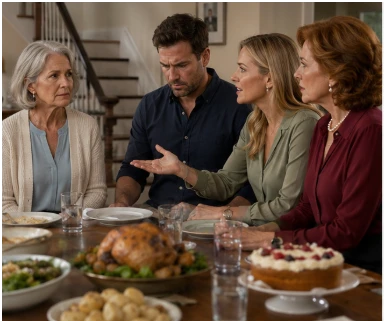
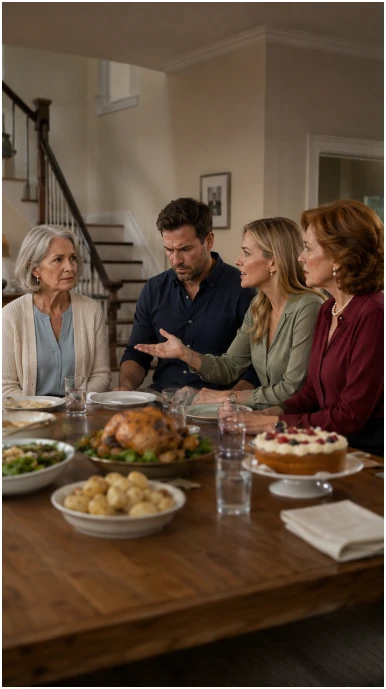
When my son got married, I didn’t tell my daughter-in-law or my son that the house they were living in was still mine. And I’m glad I did, because shortly after the wedding my daughter-in-law and her mother tried to…
When my son got married, I didn’t tell my daughter-in-law that the house they were living in was mine. And it’s a good thing I didn’t, because shortly after the wedding, my daughter-in-law and her mother tried to kick me out of my own home.
It was a Sunday afternoon. I was in the kitchen making coffee when I heard their voices in the living room. Chloe and her mother, Linda, had arrived about an hour earlier and were already measuring the walls, talking about paint colors, new furniture, and how they were going to rearrange everything as if the house were already theirs.
I walked out with the coffee pot in my hand and found them standing in front of the big dining room window. Chloe saw me and smiled, but it wasn’t a kind smile. It was the smile people give you when they’ve already decided something about you without asking.
“Eleanor,” she said to me, and she didn’t even use Mom or Mrs. Lopez like she had the first few months. Just Eleanor, as if we were friends the same age.
“Mom and I were just thinking that this house is way too big for you all alone. And since Adrienne and I live here now, it just makes more sense for you to look for a smaller apartment, something comfortable for one person, something more appropriate for your age.”
I just stood there holding the coffee pot. I could feel the heat of the glass burning my palm a little, but I didn’t let go.
Linda, her mother, nodded as if she were agreeing with something very logical, very reasonable. “It’s just that you’ll be going up and down stairs here, Eleanor,” Linda added with that fake voice of concern. “At your age, that’s dangerous. Besides, we need the space. Chloe and Adrienne are going to have children soon, and you? Well, you’ve already done your part as a mother. It’s time for you to rest.”
Rest? As if resting meant disappearing. As if I were an inconvenience that had to be stashed somewhere else so they could live comfortably in what they believed was already theirs.
I didn’t say anything. I just set the coffee pot on the table, looked at them both, and went to my room. I closed the door slowly, sat on the edge of my bed, and took a deep breath. One, two, three times. That’s what my friend Margaret taught me in the yoga group we go to on Tuesday and Thursday mornings.
“When you feel something burning you up inside, breathe,” she told me once. “Breathe and think before you act.”
And I breathed. But not because I was scared, not because I felt small. I breathed because I knew in that exact moment that I had to be very smart about what came next, because the war had already started. Chloe just didn’t know that I already had my weapons stored away.
You see, when Adrienne told me he was getting married, I was happy. I truly was. My son was 38 years old. He’d had relationships before, but nothing serious. And when he met Chloe at work, I saw how his eyes lit up when he talked about her, how he came home early just to get ready to go pick her up, how he smiled while texting on his phone.
I wanted him to be happy. I wanted him to have a partner, a family of his own, because I had already lived my life. I had been a wife. I had raised my son. I had worked for 30 years as an administrator in a government office until I retired 5 years ago.
And now, at 70 years old, I had my routine, my friends, my Saturday morning walking group, my Wednesday computer classes where I learned to use WhatsApp, Facebook, and even FaceTime with my sister who lives in San Diego.
I wasn’t some old lady lost in time. I had my life, but I also had a mother’s heart that wanted to see her son happy.
So, when Adrienne told me 2 months before the wedding that he and Chloe needed a place to live because the rent on their small apartment was just too high, I didn’t hesitate. I told them they could stay here in this house, that there was plenty of room, that as long as I lived, this house was their house, too.
But I didn’t tell him something. I didn’t tell him that the house was still in my name, that the papers, the deed, everything was still legally mine, because at one point I had thought about transferring the property to him. Yes, but something inside me, something I couldn’t explain at the time, told me, “Wait, not yet.”
And I waited. And it’s a good thing I did, because from the day of the wedding, everything changed.
Chloe arrived with three giant suitcases and put them in Adrienne’s room as if it were the most natural thing in the world. Fine, I thought. They’re husband and wife. It’s normal.
But then she arrived with boxes. Boxes and boxes of her things, clothes, shoes, decorations, pictures, and she started arranging them all over the house. In the living room, in the dining room, in the hallways.
One day, I came downstairs and saw she had taken down the portrait of my late husband that hung in the entryway. She had replaced it with a large gold-framed mirror. I felt something tighten in my chest, but I didn’t say anything. I just took the portrait up to my room and put it on my dresser.
Adrien didn’t say a word. I don’t even think he noticed.
Two weeks later, Chloe started moving the furniture around. The little table where I kept my plants was moved to the garage. The armchair where I sat to read in the afternoons was pushed into a corner, almost hidden behind a huge plant she brought in.
And when I’d come home from my walk or from Margaret’s house, I’d find everything different. As if every day my house looked less and less like my house.
But still, I didn’t say anything, because I thought, well, she lives here now, too. She has a right to feel comfortable. I’m the mother-in-law. I don’t want to be the type of mother-in-law who fights about everything. I want my son to be happy.
How stupid I was. Because Chloe wasn’t trying to feel comfortable. She was trying to erase me. And I didn’t see it until it was too late. Or rather, until it was so obvious there was no way to ignore it.
The first big sign was when she invited her mother to stay for a few days. Linda arrived on a Friday night with two suitcases and a smile I didn’t like from the start. It was the smile of someone who knows something you don’t. A winner’s smile before the game even starts.
“Oh, Eleanor, what a lovely house you have,” she said when she walked in, looking at everything as if she were appraising its value. “Chloe told me there’s so much space here. And since I’m all alone since my divorce, well, I thought I’d come for a few days to keep you girls company.”
Keep them company. Not keep us company. Keep them company, as if I were no longer part of the group.
And those few days turned into a week, and then two, and then a month. And Linda acted like she owned the place. She’d get up late, leave her things scattered all over the living room, use my bathroom without asking, use my shampoo, my lotions, even my good towels that I saved for special guests.
And Chloe said nothing. On the contrary, the two of them started making plans together. Plans about my house.
It was during that second week with Linda in the house that I started to feel something was very wrong. It wasn’t just the discomfort of having someone extra in my space. It was the way they looked at me, the way they talked when they thought I wasn’t listening.
One Tuesday morning, I had left early for my yoga class. Margaret picked me up at 7 like always, and we went together. But halfway through the class, I realized I had left my cell phone at home. I didn’t think much of it. After all, I’d be back in 2 hours.
But that day, the instructor ended the class half an hour early because of a family emergency. So, I got home at 9:30 instead of 10:00. I opened the door quietly because I didn’t want to make noise, and that’s when I heard them.
They were in the living room, Chloe and Linda. Their voices carried clearly from the dining room.
“I’m telling you, it’s the perfect time,” Linda was saying. “She’s already old. If you wait too long, it’ll get harder. You have to act now while you can still manage the situation.”
“But she’s Adrienne’s mom,” Chloe replied, though her voice didn’t sound worried. It sounded like she was thinking, calculating. “I don’t know how he’ll react.”
“Adrienne will understand,” Linda insisted. “You’re his wife. He chose you. And if you explain it to him properly, if you make him see it’s for the best, he’ll be on your side. Men always take their wives’ side when they know they’re right.”
I stood frozen in the entryway, my bag still hanging from my shoulder, my heart beating so hard I thought they would hear it from the living room.
Besides,” Linda continued, “think about it. This house is huge. Three bedrooms, two full baths, living room, dining room, big kitchen, a yard. Why does she need all this space for herself? It’s a waste. And you two wanting to have kids, starting your life together. It makes much more sense for her to go to a small place and leave the house to you.”
“But the house is hers,” Chloe said. And for a second, I thought she was going to defend something. But then she added, “Although Adrienne told me his mom promised she’d leave it to him one day. So technically, it’s almost ours already.”
Almost ours. As if my house, the house I worked 30 years for, the house where I buried the memories of my husband, the house where I raised my son, was already hers just because my son had gotten married.
“Then it’s settled,” Linda said in that voice of someone who has just won an argument. “If he already knows the house is going to be yours, it’s just a matter of speeding up the process. Talk to Eleanor nicely. Tell her you looked at some nice apartments nearby, that she’ll be more comfortable. That way she won’t have to worry about maintaining such a big house. And you just push little by little until she says yes on her own.”
“And if she doesn’t want to?” Chloe asked.
“Then you make her uncomfortable,” Linda replied, and her voice turned cold. “Move her things, take over her spaces, make her feel like she doesn’t have a place here anymore. Old people get tired quickly. They don’t like conflict. If you make her life miserable, she’ll want to leave on her own.”
I felt something break inside me. It wasn’t sadness. It wasn’t surprise. It was clarity. Absolute clarity about what was happening, about what had been happening for weeks.
I turned around slowly, left the house without making a sound, and stood on the sidewalk. I breathed one, two, three times. Then I took out my cell phone and called Margaret.
“Eleanor, what’s wrong? Did you forget something?”
“Margaret,” I said, and my voice came out firmer than I expected, “can you come pick me up? I need to talk to you.”
“Are you okay?”
“Yes, but I need to get out of here right now.”
Margaret didn’t ask any more questions. “I’ll be there in 10 minutes.”
I waited on the corner of my street until I saw her car. I got in, and before she could ask me anything, I said, “Let’s go get breakfast. I’ll tell you everything.”
We went to a diner that’s near the farmers market, a quiet place that sells biscuits and gravy and good black coffee. We sat at a booth in the back, and I told her everything. From the day Chloe had suggested I leave to the conversation I had just overheard.
Margaret listened to me in silence. When I finished, she put her hand on mine and squeezed.
“Eleanor, that girl and her mother want to kick you out of your own house.”
“I know.”
“And what are you going to do?”
“I don’t know yet,” I admitted. “But I’m not going to stand by quietly and watch them erase me from my own life.”
Margaret nodded. “The house is in your name.”
“Yes, everything is in my name. The papers, the deed, all of it.”
“Does Adrienne know that?”
“No, we never talked about it. He just thinks I’ll leave it to him someday. And yes, that was the plan. But I never signed anything. I never did any paperwork. The house is still mine.”
Margaret thought for a moment. Then she looked at me with that look she gets when she’s about to say something important.
“Eleanor, you know what you have to do, right?”
“What?”
“Don’t tell them anything. Not yet. Let them go on with their plan. Let them get confident. And in the meantime, you prepare your defense.”
“My defense?”
“Yes. Go see a lawyer. Make sure all your paperwork is in order. Document everything you can. And when the time comes, when you can’t take it anymore, then you show them whose house it really is.”
I just stared at her. Margaret is 72, 2 years older than me, but she’s always been the smart one. She was an elementary school teacher for 40 years. She knows how to handle difficult situations. She knows when to speak and when to stay quiet.
“You think I should do that?”
“I think you need to protect yourself, Eleanor. And if your son isn’t protecting you, if he’s allowing his wife and his mother-in-law to disrespect you in your own home, then you have to protect yourself.”
She was right. Margaret is always right.
I went home that afternoon with a clear idea. I wasn’t going to fight. I wasn’t going to yell. I wasn’t going to make a scene. I was going to be smart. I was going to observe. I was going to document. And when the time came, I was going to act.
That night during dinner, Chloe told me she had seen some very nice apartments near downtown, that they were perfect for a single person, that they had an elevator and everything.
“That way, you wouldn’t have to climb stairs. They even have a common area where the residents get together,” she told me with that fake smile. “You could make new friends, Eleanor. People your age.”
Adrienne was sitting next to her, eating his chicken in silence. He didn’t say anything. He didn’t defend me. He just ate, his eyes fixed on his plate as if nothing was happening.
“Oh, that sounds interesting,” I said to Chloe, pretending to care. “Send me the information on WhatsApp.”
She smiled even wider. “Of course, Mom. I’ll send it to you first thing tomorrow.”
Mom. Now, she was calling me Mom because she thought she had won. But she hadn’t won anything.
That night, when everyone else was asleep, I stayed awake in my room with my phone. I Googled property lawyers in my city. I found three options. I saved the numbers. Then I opened my photo gallery and started taking screenshots of everything. Of Chloe’s messages, of pictures of my house, how it was before and how it was now, everything.
At 2 in the morning, I fell asleep, but not with fear, not with sadness. I fell asleep knowing the war had begun, but that I knew how to fight, too.
The next few days were strange. I went about my normal routine as if nothing was wrong. I got up early, made coffee, went walking with my group on Saturdays, went to yoga with Margaret on Tuesdays and Thursdays.
But inside, I was completely alert, watching, noting everything in my head.
Chloe sent me the information on the apartments via WhatsApp, just as she’d promised. There were three options, all small, all cheap, all in neighborhoods I didn’t know. I thanked her and told her I’d think about it. She replied with a smiley face emoji and a heart, as if she were doing me a favor.
But things in the house kept changing. Every day, something new.
One Thursday, I came home from grocery shopping and found they had moved all the living room furniture again. The main sofa was now against the window. The coffee table I had bought 15 years ago was shoved into the garage. And in its place was a new glass table I had never seen before.
“Do you like it?” Chloe asked when she saw me looking. “We bought it yesterday. It’s modern. Gives the living room a different feel. Don’t you think?”
We bought it. She and who?
Adrienne hadn’t said anything. And I didn’t say anything either. Not at that moment. I just nodded and went to the kitchen to put away my vegetables.
But when I got to the kitchen, I saw something that made me stop cold. All my pots, the ones I had used for 30 years, were stacked in a cardboard box next to the refrigerator. And on the stove were new pots, stainless steel, shiny, expensive pots I had not bought.
“Oh, yeah,” Chloe said, walking in behind me. “We updated the pots, too. Yours were looking pretty old, Eleanor. These are non-stick. Much better. We’re going to donate yours.”
Donate my pots. The pots I had cooked in for my husband for 20 years. The pots where I made Adrien his favorite meal every birthday. The pots that held the memory of thousands of dinners, thousands of moments.
“I see,” I said, and my voice came out colder than I expected. “But those pots are mine. And if anyone is going to donate them, it will be me.”
Chloe blinked. For the first time, I think she noticed I wasn’t completely on board with everything she was doing, but she recovered quickly.
“Oh, Mom, of course. Whatever you say. We just wanted to help modernize the house a bit.”
Modernize. That word again. As if everything of mine was old and needed to be replaced. As if I were old and needed to be replaced.
That night after dinner, I locked myself in my room and took out the house papers, the original documents, the deed that had been in my name for 35 years. I read them completely, line by line. I wanted to be absolutely sure.
And yes, there it was. Eleanor Lopez, sole owner. No other name, no other signature.
The next day, a Friday morning, I called the first lawyer on my list. A very polite receptionist answered.
“Good morning. My name is Eleanor Lopez, and I need a consultation regarding a property matter.”
“Of course, ma’am. When would you like to come in?”
“Do you have anything available this week?”
“Let me check. Yes, we have an opening on Monday at 10:00 in the morning.”
“Perfect. I’ll be there.”
I gave her my information and hung up. I felt a strange tightness in my chest. It wasn’t fear. It was determination. For the first time in weeks, I felt like I was taking control of my own life.
The weekend was quiet but tense. Chloe and Linda spent it measuring the walls of the spare room next to mine, the room where I kept my things, my books, my winter clothes, some boxes with photos and memories.
“This will be the baby’s room,” I heard Chloe say. “We’ll paint it a light yellow and put a crib here by the window.”
A baby. She wasn’t even pregnant yet. And they were already planning to take over every corner of my house. They were already erasing me room by room, space by space.
Adrien was acting strange, quiet, distant. Sometimes I’d see him looking at me as if he wanted to say something, but then Chloe would arrive and he’d go back to his silence. It made me sad to see him like that. My son, the boy I raised alone. The boy I taught to tie his shoes, to ride a bike, to be respectful and honest.
That boy was now a man who didn’t know how to defend his own mother, or worse, a man who had chosen not to defend her.
On Sunday night, Linda made dinner. Without asking my permission, she used my kitchen as if it were hers. She made chicken and green salsa with rice. She set the table in the dining room, and when we sat down to eat, she spoke as if she were the host of the party.
“Well, family,” she said, raising her water glass as if for a toast, “I want to propose something. Chloe and I have been thinking it would be a good idea to do a complete remodel of the house. Change the floors, paint all the walls, update the bathrooms. What do you all think?”
Adrienne looked at her, surprised. “A remodel? That costs a lot of money.”
“Yes, but it’s worth it,” Chloe insisted. “This house has so much potential. It just needs an update. And we can get a loan. With your salary and mine, we can pay it off in 2 years.”
A loan to remodel my house. The house that was still mine.
“And what do you think, Mom?” Adrienne asked, turning to look at me for the first time all dinner.
They all looked at me. Chloe with that smile that no longer fooled me. Linda with a challenging look, waiting for me to say something so she could attack. And Adrien, my son, looking at me with exhaustion, as if my opinion were just a formality he had to get through.
“I think,” I said slowly, choosing each word with care, “that a remodel is a very big and very expensive undertaking, and that we should think it through very carefully before deciding.”
“But Mom,” Adrienne insisted, “if the house is going to be mine someday anyway, right? You told me so yourself. So it makes sense to invest in it now. So when I inherit it, it’s already nice.”
There it was, the truth coming out all on its own. Adrien believed the house was already practically his, that it was just a matter of time, and Chloe and Linda had used that belief to build their entire plan.
“Yes, Adrien,” I said, staying calm. “Someday this house might be yours. But that day hasn’t come yet. And as long as that day hasn’t come, the big decisions about this house are made by me.”
An uncomfortable silence fell. Chloe stopped smiling. Linda pressed her lips together, and Adrienne looked at me, confused, as if I had just said something completely unexpected.
“So, you don’t want us to remodel?” Chloe asked, and her voice was no longer sweet. It was sharp.
“I didn’t say that,” I replied. “I said it’s something we need to think about calmly, without rushing.”
“But we live here,” Linda cut in. And there it was, the real venom finally coming out. “We also have a right to an opinion about what the house we live in looks like.”
We, as if she lived here permanently too. As if she had any right to my home.
“Of course, you have a right to an opinion,” I said, getting up from the table. “But I have the right to decide because this house is mine.”
And I went to my room. I closed the door. And for the first time in weeks, I felt something like power, like control.
Monday morning, I got dressed early. I put on my favorite pink blouse, the one Margaret gave me last year. I put on a little makeup. I fixed my hair. And at 9:30, I left the house without telling anyone where I was going.
The lawyer’s office was downtown in a four-story building. I took the elevator to the third floor and knocked on the door that said Law Offices of Gregory Hayes, Civil and Family Law.
A man in his 50s with glasses and a kind smile greeted me. “Mrs. Lopez, please come in. Have a seat. Tell me, how can I help you?”
And there, sitting across from that desk full of books and folders, I told him everything from the beginning, from the day Adrienne got married to the dinner on Sunday. I showed him the papers for the house. I explained that I had never signed anything ceding the property, that everything was still in my name.
Mr. Hayes listened to me intently, taking notes in a legal pad.
“Mrs. Lopez,” he said when I finished, “you have every legal right on your side. This house is yours. Completely yours. And nobody, absolutely nobody, can force you to leave it or to sign over your property if you don’t want to.”
“Not even my son?”
“Not even your son. You can leave the house to him in your will when you decide, or you can never leave it to him. That is your decision.”
I felt an enormous sense of relief, as if someone had finally told me I wasn’t crazy, that I wasn’t being selfish, that I had the right to defend what was mine.
“So, what do you recommend I do?” I asked Mr. Hayes.
He leaned back in his chair, folded his hands on his desk, and looked at me seriously.
“First, I need you to understand something important, Mrs. Lopez. You are under no legal obligation to allow your daughter-in-law, her mother, or even your son to live on your property if you do not wish it. They are there because you allowed them to be, out of your own goodwill, not out of obligation.”
“But Adrien is my son.”
“I know. And I understand this is an emotionally delicate situation. But legally, you hold all the cards. Now, my recommendation is this. Document everything. Record conversations if you can. Take photos, save text messages, anything that proves they are trying to pressure you to leave your own home. That could be useful later if the situation gets more difficult.”
“More difficult how?”
“Well, in some cases, people try to accuse the property owner of abandonment or of having verbally gifted them the rights. It’s rare, but it happens. If you have proof that they knew the house was yours and still tried to get you out, that protects you completely.”
I nodded, processing every word.
“And if I wanted them to leave, can I just ask them to vacate my house?”
“Of course. It’s your house. You can ask them to leave whenever you want. If they refuse, then we would have to begin a formal eviction process. But with the paperwork in order as you have it, it would be a relatively simple process.”
I was silent for a moment. The word eviction sounded so harsh, so cold, but it also sounded like justice.
“How much would all this cost? I mean, if I needed your help later.”
“Today’s consultation is no charge. It’s complimentary. If you later need me to initiate any legal action, we can discuss the fees at that time. But to be honest with you, Mrs. Lopez, I hope it doesn’t come to that. I hope you can resolve this within the family.”
I thanked him. I shook his hand and walked out of that office feeling stronger than when I went in. I had an ally. I had information. I had a plan.
When I got home, it was almost noon. I walked in and found Chloe and Linda in my bedroom. My bedroom. The door was wide open, and they were going through my closet.
“What are you doing?” I asked from the doorway, and my voice was louder than I expected.
Chloe spun around, startled. Linda didn’t even flinch.
“Oh, Eleanor, you scared us,” Chloe said, putting a hand to her chest. “We were just looking at your clothes. You have so many things you don’t wear anymore, don’t you? We thought we could do a clean-out and donate what you don’t need.”
“Who gave you permission to come into my room?”
“Oh, Mom, don’t be upset. We just wanted to help.”
“I don’t need that kind of help,” I said, walking toward them. “And I want you to get out of my room now.”
Linda looked at me with that offended expression I had come to know so well.
“You don’t have to be rude, Eleanor. We were just trying to help you get organized. At your age, it’s easy to accumulate things that are no longer useful.”
At your age. That phrase again, as if I were an old woman incapable of managing my own things.
“Out,” I repeated, and this time I stood in the doorway with my arms crossed. “Both of you, out of my room.”
Chloe left first, her head down like a scolded child. But Linda brushed past me and looked me directly in the eye.
“You’re being very selfish, Eleanor. This family is trying to move forward, and you’re just in the way.”
In the way. There it was. The word they had been thinking all this time but hadn’t dared to say out loud. I was an obstacle in my own house, in my own life.
I didn’t answer her. I just closed the door when they left and sat on my bed. My hands were shaking, but not from fear. It was rage. Pure rage, and something else. Something that had been growing inside me for weeks and that I could no longer ignore. Exhaustion.
Exhaustion from being invisible. Exhaustion from being treated like old furniture. Exhaustion from my own son saying nothing when I was disrespected.
I took out my phone and opened the voice recorder app. Mr. Hayes had told me to document everything, and that’s what I was going to do. I recorded a message for myself describing what had just happened, the date, the time, what they said, how they entered my room without permission.
Then I opened WhatsApp and texted Margaret. I need to see you today. Are you free?
She replied in less than a minute. Of course. 5:00 at the diner.
Perfect.
The rest of the day, I stayed in my room. I didn’t go down to eat. I didn’t want to see anyone. I heard Adrienne come home from work. I heard voices in the living room, conversations I couldn’t make out, and I didn’t care.
At 4:30, I got ready and left. No one asked me where I was going. They didn’t even look up when I walked through the living room.
Margaret was already at the diner when I arrived. She saw me walk in and knew immediately something had happened.
“What happened, Eleanor?”
I sat across from her and told her everything. The visit to the lawyer, what he told me, what happened with Chloe and Linda in my room. Everything.
Margaret listened in silence, nodding occasionally. When I finished, she sighed deeply.
“Eleanor, you know what you have to do.”
“What?”
“You have to get them out of your house. Both of them. Chloe and her mother.”
“But Chloe is married to Adrien.”
“I don’t care. That girl and her mother are disrespecting you in your own home. And your son is doing nothing to protect you. So you have to protect yourself.”
“But if I kick Chloe out, Adrien will go with her.”
“Maybe he will. Maybe he won’t. But you know what, Eleanor? If your son chooses a woman who mistreats you over his own mother, then let him go. Because a son who doesn’t defend you, who doesn’t respect you, who allows you to be treated like this, that son already lost you a long time ago.”
Her words hurt because they were true. Adrienne was no longer the boy I raised. He was a man who had chosen the easy path, the silence, the comfort of not getting into trouble. And in the process, he had abandoned me.
“I don’t know if I can do it,” I admitted, and I felt tears start to form in my eyes.
“Yes, you can,” Margaret said, taking my hand. “You are the strongest woman I know. You raised your son alone. You worked for 30 years. You paid for that house with your own hard work. And now some girl who just showed up a few months ago wants to take it all away. Are you going to let her?”
“No.”
“Then I’m going to fight.”
Margaret smiled. “That’s more like it.”
That night, I returned home with a decision made. But I wasn’t going to act immediately. Not yet. First, I needed them to dig their own graves. I needed them to get so confident, to do something so obvious, so blatant, that there would be no way for Adrien to defend them.
And I didn’t have to wait long.
Two days later, a Wednesday afternoon, I came home from my computer class and found Chloe in the living room on the phone. When she saw me walk in, she lowered her voice, but she didn’t hang up.
“Yeah, Mom. I’m telling you, it’s almost time. Just a matter of time. No, she hasn’t said anything yet, but she’s giving in. Yeah, when she leaves, we’re going to change everything. I already spoke to a contractor to come and see about the remodel. He figures about $15,000 to do it all right. Don’t worry, we’ll get it from the loan. The house is going to be ours anyway.”
My blood ran cold. $15,000. A loan to remodel my house, the house they thought was already theirs.
Chloe saw me standing there and hurried to hang up. “I’ll call you later, Mom. Bye.”
She looked at me with a nervous smile. “Did you hear that?”
“Yes.”
“It’s just, well, we already talked to Adrien and he agrees. We’re going to apply for the loan next week. The house is going to be beautiful, Eleanor. You’ll see.”
“And was anyone going to consult me?”
“Well, it’s just Adrienne said you had already accepted that the house was going to be his.”
“Accepting that it might be his someday is not the same as saying it’s his now,” I said, my voice sharper than I intended. “And I definitely did not give permission for anyone to take out a loan in my name.”
“It won’t be in your name,” Chloe clarified quickly. “It’ll be in Adrienne’s name.”
A $15,000 loan to remodel a house that isn’t his.
Chloe fell silent. For the first time, I think she saw something in my eyes that scared her.
“Eleanor, we just want to improve the house.”
“No,” I said slowly. “You want to erase me. You want me to leave. You want to take what I built. But you’re in for a surprise.”
And I went to my room before she could answer.
That night during dinner, Adrienne brought it up.
“Mom, Chloe told me you were upset about the loan.”
“I wasn’t upset, Adrien. I was concerned because you are planning to spend $15,000 on a house that is still mine without even asking me.”
“But Mom, you said the house would be mine someday.”
“Someday, Adrien. Someday. Not today. Not next week. And until that day comes, I am still the owner. I still decide what does and doesn’t get done in this house.”
Chloe jumped in. “It’s just that we don’t know what you want anymore, Eleanor. Sometimes it seems like you want us to leave.”
And there it was, the trap waiting for me to say yes, that I wanted them to leave so they could play the victims. But I was learning to play this game.
“I don’t want you to leave,” I said calmly. “I just want respect. Respect in my own home.”
After that dinner, things changed. Chloe and Linda stopped pretending. There were no more fake smiles or attempts to be nice. Now they just ignored me. They’d walk past me as if I were invisible. They’d talk loudly to each other about their plans, about the remodel, about how they would arrange the rooms when the children arrived.
And Adrienne remained in the middle, quiet, uncomfortable, not taking anyone’s side.
One Saturday morning, while I was on my walk with the group, Margaret asked me how things were going.
“Bad,” I told her. “Worse every day. They don’t even pretend anymore. They talk as if I don’t exist.”
“And your son?”
“My son says nothing. He pretends not to see, not to hear.”
Margaret shook her head. “Eleanor, how long are you going to put up with this?”
“Not much longer,” I admitted. “I’m just waiting for the right moment.”
“The right moment for what?”
“To show them who owns that house.”
Margaret smiled. “There’s my friend, the Eleanor I know.”
That same afternoon, when I got home, I saw something that made me make the final decision. There was a truck parked in front of my house. A truck from a construction company. And in the entryway, Chloe was talking to two men carrying rolled-up blueprints.
I approached them slowly. “What’s going on here?”
Chloe turned and looked at me with a mix of defiance and nervousness.
“It’s the contractors, Eleanor. They came to give an estimate for the remodel.”
“The estimate? Without consulting me?”
“Well, Adrienne already gave the okay.”
“And Adrienne is not the owner of this house,” I interrupted, and I looked directly at the two men. “Gentlemen, I’m sorry you came all this way, but there will be no remodel. This is my house, and I did not authorize any work.”
One of the men looked at Chloe, confused. “Ma’am, you called us and said it was urgent we come out to measure.”
“I called them,” Chloe said, “because I live here and I have a right to improve my home.”
“Your home?” I repeated, and I felt the rage rise in my throat like fire. “Your home, Chloe?”
“Well, Adrienne’s home. It’s the same thing.”
I turned back to the contractors. “Gentlemen, this house is in my name. Eleanor Lopez. You can check the public record if you like. And I repeat, there is no work authorized here. So I’m asking you to please leave.”
The men looked at each other, uncomfortable. Then one of them nodded.
“Understood, ma’am. We’re sorry for the misunderstanding.”
They left. And I stood there in front of Chloe, my heart pounding so hard I thought it would explode.
“How dare you?” I said. “How dare you call contractors to my house without my permission?”
“It’s because you don’t want to improve anything,” Chloe shot back. And now her voice had no sweetness at all. It was pure venom. “This house is old. It’s ugly. It’s outdated. And you won’t do anything to fix it.”
“Because it’s my house. And I like it the way it is.”
“Well, we don’t. We’re going to live here, so we have a right to an opinion.”
“An opinion, yes. A decision, no. Because this house is mine, Chloe. Mine. Not yours. Not Adrienne’s. Mine.”
“But Adrienne said you were going to leave it to him someday.”
“When I decide to. But that day isn’t today. And the way things are going, that day might never come.”
Chloe looked at me like I had slapped her. She opened her mouth to say something, but just then, Linda arrived.
“What happened? Why did the truck leave?”
“Because Eleanor kicked them out,” Chloe said, her voice trembling. “Because she doesn’t want us to fix anything, because she wants us to live in this horrible house forever.”
“Oh, Eleanor,” Linda said, approaching with that superior attitude that bothered me so much. “We get it. You don’t want to cooperate. You don’t want to help. You just want to keep everything as it is because you’re selfish.”
“Selfish?” I repeated. “I’m selfish because I don’t want you to do whatever you please in my own home?”
“This house should belong to your son,” Linda said. And now her voice was hard, with no pretense of kindness. “A son you emotionally abandoned for years while you worked all day. A son who needed a mother, but you preferred your career.”
I froze. How dare she? How dare this woman who didn’t know me, who knew nothing about my life, judge me like that?
“I worked,” I said, my voice shaking, “because Adrienne’s father died and someone had to put food on the table. I worked for 30 years to give him an education, clothes, a roof over his head. I worked to buy this very house, and now you come here, having done nothing, having contributed nothing, and tell me I’m a bad mother.”
“I didn’t say you were a bad mother,” Linda retorted. “I said you abandoned him emotionally. And it’s true. That’s why Adrienne is with us now, because we take care of him. We make him feel loved.”
I looked at both of them, at Chloe, her eyes shining with rage, at Linda, with that cruel smile enjoying every second of my pain, and I understood something very clearly.
This wasn’t just about the house anymore. This was about destroying me completely.
“Get out of my sight,” I said in a low voice. “Both of you. Now.”
“This is our house, too,” Chloe insisted.
“No, it’s not. And if you don’t get out of my sight right this minute, I will remove you myself.”
I don’t know what they saw in my eyes, but something made them back down. They went into the living room, and I went straight to my room. I locked the door. I sat on the floor and I cried.
I cried from rage. I cried from sadness. I cried for my son who wasn’t there to defend me. I cried for all the years I worked alone, sacrificed alone, and fought alone to give him a decent life. And I cried because now, at 70 years old, I had to keep fighting alone.
But after I cried, I wiped my tears. I stood up and grabbed my phone. I dialed Mr. Hayes.
“Good afternoon, Mrs. Lopez. What can I do for you?”
“I need you to prepare the papers,” I said, and my voice was no longer shaking. “I want Chloe Torres and Linda Torres out of my house.”
“I have 30 days to notify them, correct?”
“That’s correct.”
“Then I want you to prepare a formal legal notification. They have 30 days to vacate my property, and I want you to come and serve it to them personally.”
“Are you sure, Mrs. Lopez?”
“Completely sure.”
“Very well. I’ll have the documents ready by Monday. When would you like me to deliver them?”
“Next Sunday. During lunch. I want the whole family to be present.”
There was a silence on the other end of the line.
“Understood. I’ll be there.”
I hung up and took a deep breath. It was done. There was no turning back. And for the first time in months, I felt something like peace.
The following week was the longest of my life. Every day that passed, I knew what was coming. I knew that Sunday would change everything. And in the meantime, I had to keep living in the same house with Chloe and Linda, pretending everything was normal.
They were acting strange, too. Whispering to each other, looking at me sideways, but they no longer spoke to me directly. It was as if they were waiting for me to explode, to yell at them, to leave. But I did none of that. I just stuck to my routine. I went for my walks, went to yoga with Margaret, came home, and locked myself in my room.
On Tuesday, Margaret asked if I had spoken to Adrien.
“No, I haven’t spoken to him since the incident with the contractors.”
“And he hasn’t come to you?”
“No. He just holes up in his room with Chloe or leaves early for work. I think he’s afraid to face the situation.”
“Are you scared about what’s going to happen on Sunday?”
“Yes,” I admitted. “But I’m more scared of staying quiet and letting them walk all over me.”
Margaret nodded. “You’re doing the right thing, Eleanor. You’ll see.”
On Thursday, a message from Chloe came through on the family group chat we had, Adrien, her, and me. It was strange because no one had written in it for weeks.
Family, I propose we have a special lunch this Sunday. My treat. I want us to have a nice moment altogether.
I read the message three times. A special lunch, right now? It was too much of a coincidence. Either she was planning something, or she genuinely wanted to make peace. But after everything that had happened, I no longer believed in her good intentions.
Adrienne replied, Sounds good. What are we having, Chloe?
I’m making your favorite roast chicken with potatoes. And for dessert, the tres leches cake you love.
I didn’t respond. I just left the message on read.
Friday night, as I was lying in bed, scrolling through my phone, I heard voices in the living room. It was Chloe, Linda, and Adrien. They were talking loudly, as if they no longer cared if I heard them.
“Sunday will be perfect,” Linda was saying. “We’ll show her that we are a united family, and if she wants to remain part of this family, she has to cooperate.”
“And if she doesn’t cooperate?” Adrienne asked.
“Then we’ll have to take more drastic measures,” Chloe replied. “Adrien, you know your mom is getting old. She’s stubborn. She’s confused. Maybe she needs professional help.”
Professional help. Were they implying I was crazy?
“Chloe, don’t exaggerate,” Adrienne said. But his voice sounded weak, unconvinced.
“I’m not exaggerating. Your mom is behaving irrationally. She won’t let us improve the house. She treats us poorly. She makes us feel unwelcome. That’s not normal, Adrien.”
I lay there frozen, listening. They were building a narrative. They were painting me as the crazy one, the problem, the one who was wrong. And Adrienne was listening to them, not defending me.
I grabbed my phone and opened the recorder. I turned up the sensitivity and let it record everything. Every word, every accusation, every lie.
Saturday morning, Chloe and Linda went out to buy the groceries for the Sunday lunch. I used that moment to talk to Adrien. I found him in the living room watching television.
“Adrien, I need to talk to you.”
He muted the TV and looked at me, weary. “What is it, Mom?”
I sat across from him and looked him in the eye. My son, my only son, the boy I had raised alone.
“Why don’t you defend me?”
Adrien looked down. “Mom, I don’t want to be in the middle of this.”
“But you are in the middle. You live here. You see how they treat me. You hear how they talk to me. And you say nothing.”
“It’s just that you don’t compromise either,” he said. And his voice was full of complaint. “Chloe just wants to make improvements to the house. She wants us to live nicely. And you oppose everything.”
“I oppose them making decisions about my house without consulting me. There’s a difference.”
“But Mom, you said the house would be mine someday.”
“Someday, Adrien, not today. Why is that so hard to understand?”
He fell silent.
“You know what I think?” I continued. “I think Chloe has you convinced that I’m the problem, that I’m the one who’s wrong, that I’m the one not cooperating. But the truth is, ever since she arrived, everything has changed, and not for the better.”
“Chloe is my wife, Mom.”
“I know. And I want you to be happy with her, but not at the cost of me losing my dignity in my own home.”
Adrienne stood up from the sofa. “We’re having a family lunch tomorrow. I hope you can come with a better attitude.”
And he went to his room. I just sat there alone in the living room. And I understood that my son had already chosen, not me, them.
Sunday arrived. I got up early, took a long shower, put on my favorite brown dress, the one my sister gave me. I did my makeup, fixed my hair, and put on my pearl earrings. I wanted to look good. I wanted to look strong.
By noon, Chloe was already in the kitchen preparing the food. Linda was setting the table in the dining room, and Adrienne was helping with the drinks. It looked like a normal family scene, but I knew none of it was normal.
At 1:00 in the afternoon, everything was ready. The table was set. The chicken smelled delicious. The tres leches cake was in the fridge, and they were all seated, waiting for me to come down.
I walked down the stairs slowly. The three of them looked at me as I entered the dining room.
“So glad you decided to join us, Eleanor,” Linda said with that fake smile.
“Sit down, Mom,” Adrienne said, pointing to my usual chair.
I sat. Chloe served the chicken. Linda passed the potatoes. Adrienne filled the glasses with iced tea. And for a few minutes, we ate in silence.
Then Chloe cleared her throat.
“Well, family, I invited you to this lunch because I wanted to talk about something important.”
Here it came, whatever they had planned.
“As you know,” Chloe continued, “Adrienne and I want to start our own family. We want to have children. We want to build our future. And for that, we need stability.”
I looked at Adrien. His eyes were fixed on his plate.
“That’s why,” Chloe went on, “we’ve been thinking that the best thing would be for you, Eleanor, to find a place that’s more suitable for you. A place where you’ll be comfortable, where you won’t have to worry about maintaining such a big house. There are some very nice senior living communities, places where you can make friends, have activities, be well cared for.”
Senior living communities. A nursing home. They wanted to put me in a nursing home.
“And what do you think about this, Adrien?” I asked without looking at him.
There was a long silence. Then I heard his voice, quiet, almost inaudible.
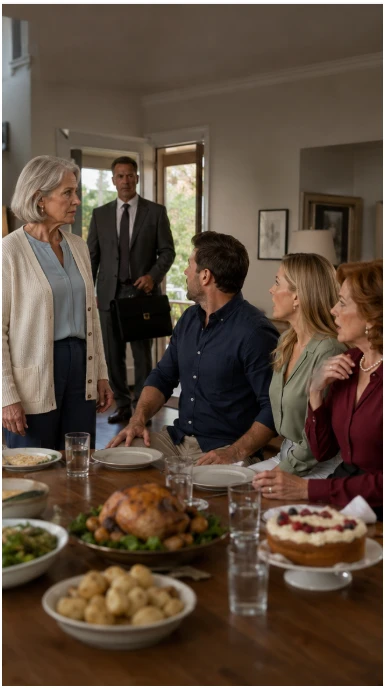
“I think… I think it could be a good option, Mom. So you can be more relaxed.”
I felt something shatter inside me. My own son, my only son, was agreeing to send me to a nursing home to get my house.
“I see,” I said, and my voice came out calmer than I expected. “So, you want me to leave my house so you two can stay here?”
“It’s not like that, Eleanor,” Linda interjected. “It’s for your own good.”
“For my own good,” I repeated. “Sending me to a nursing home is for my own good.”
“It’s a community, not a nursing home,” Chloe corrected. “And yes, we think you’d be better off there.”
I nodded slowly. I folded my napkin. I placed it on the table, and I stood up.
“Where are you going?” Adrienne asked.
“To answer the door. Someone is here.”
“Who?”
Just then, the doorbell rang. I walked to the door and opened it. There stood Mr. Hayes, briefcase in hand, a serious expression on his face.
“Good afternoon, Mrs. Lopez.”
“Good afternoon, Mr. Hayes. Please come in.”
Mr. Hayes entered the house and walked behind me toward the dining room. Chloe, Linda, and Adrienne looked at us, confused. The atmosphere changed instantly. There were no more smiles, just tension.
“Who is this?” Chloe asked, standing up.
“Family,” I said, my voice clear, “I’d like to introduce Mr. Hugo Hayes. He is my lawyer.”
I saw the color drain from Chloe’s face. Linda sat frozen in her chair. And Adrienne stared at me, wide-eyed, processing what I had just said.
“Your lawyer?” Adrienne repeated. “Why do you need a lawyer, Mom?”
“To protect what’s mine,” I replied. “Please, everyone, sit down. Mr. Hayes has something to deliver to you.”
No one moved. Mr. Hayes opened his briefcase and took out three white envelopes. He placed them on the table.
“Good afternoon,” he said in a professional tone. “My name is Hugo Hayes, and I am the legal representative of Mrs. Eleanor Lopez. I am here today to deliver an official notification.”
“Notification of what?” Linda asked, her voice no longer sounding so confident.
Mr. Hayes opened the first envelope and began to read.
“By means of this letter, notice is hereby given to Mrs. Chloe Torres and Mrs. Linda Torres that they have a period of 30 calendar days, beginning today, to vacate the property located at…”
“Wait, what?” Chloe interrupted. “Vacate?”
“Allow me to finish.”
The lawyer continued. “…the property located at 847 Maple Drive, which is the sole and exclusive property of Mrs. Eleanor Lopez, according to public deed number 2,456 of the public property registry. Mrs. Lopez, in her right as the owner, has decided to revoke permission for the aforementioned individuals to reside in her home.”
“She can’t do that!” Linda shouted, jumping up from her chair. “My daughter is married to Adrien. This is their house.”
“No, ma’am,” Mr. Hayes replied calmly. “This house is the property of Mrs. Eleanor Lopez. Your daughter and her husband have lived here by the owner’s goodwill, but that goodwill can be revoked at any time.”
Chloe turned to me, her eyes filled with rage.
“How could you do this to us? We’re your family.”
“Family?” I repeated, and I felt my voice break just a little. “You wanted to send me to a nursing home to take my house. That’s family?”
“But the house was going to be Adrienne’s,” Chloe insisted.
“Was going to be someday, when I decided. But you couldn’t wait. You wanted to kick me out ahead of time. You wanted to erase me from my own life.”
Adrien was in shock, staring at the papers on the table as if he couldn’t believe what was happening.
“Mom, are you really doing this?”
“Yes, Adrien, I really am.”
“What about me? Are you kicking me out, too?”
I stared at him. My son, the boy I had raised, the man who had disappointed me.
“That’s up to you,” I said. “Chloe and her mother have 30 days to leave. You can stay if you want, but if you decide to go with them, that is your decision.”
“You can’t separate me from my wife!” Adrienne yelled.
“I’m not separating you from anyone. I’m giving you a choice.”
Linda advanced on me, pointing her finger.
“You are a selfish, bitter, lonely old woman. That’s why your husband died, to get away from you.”
I felt the air rush out of my lungs as if her words were physical blows. But before I could respond, Mr. Hayes stepped in.
“Ma’am, I strongly advise you to moderate your language. Any threat or verbal assault against my client can and will be used against you if this escalates to a legal proceeding.”
“Legal proceeding?” Chloe laughed, but it was a nervous, desperate sound. “Eleanor, this is ridiculous. You’re not going to take us to court. You don’t have the money. You don’t have the strength.”
“You underestimate me,” I replied. “You have always underestimated me. You thought I was a foolish old woman who would let you do whatever you wanted. But you were wrong.”
Mr. Hayes handed them each an envelope. “Here are your notifications. You have 30 days. I recommend you seek legal counsel if you wish, but I’ll tell you right now that Mrs. Lopez’s documentation is ironclad. This house is legally hers, and she has every right to decide who lives here.”
Chloe took the envelope with trembling hands. Linda threw hers on the table.
“This isn’t over,” Linda sneered. “We’re going to fight this. We’ll prove you’re incompetent, Eleanor. That you’re not in your right mind. That you need a conservator.”
“Try it,” I said. And for the first time in months, I felt powerful. “I am 70 years old, but my mind is perfectly clear. My medical exams are up to date. I have witnesses to how you’ve treated me. I have recordings of your conversations. I have everything I need to prove that you are the ones who are wrong, not me.”
Linda fell silent. Chloe burst into tears.
“Adrien, say something,” she sobbed, grabbing my son’s arm. “Don’t let your mom do this to us.”
Adrienne looked at me. For the first time in months, he really looked me in the eyes.
“Mom, do you really want to do this? Do you really want to destroy this family?”
“I’m not destroying it, Adrien. It was already destroyed. From the day you let your wife disrespect me. From the day you said nothing when her mother insulted me. From the day you agreed with the idea of sending me to a nursing home to get my house.”
“I didn’t want to send you to a home,” Adrienne said. But his voice was weak.
“But you didn’t defend me when they suggested it either. You stayed quiet, and that silence hurts more than any insult.”
Chloe let go of Adrienne’s arm and faced me directly.
“You know what? I’m leaving. I’m leaving this horrible house and this bitter old woman. But I’m taking your son with me because he loves me, not you.”
I stayed silent, waiting. Waiting for Adrien to say something. Waiting for him to defend me, even just this one last time.
But he didn’t.
“Adrien,” Chloe said, “let’s go pack. We’re leaving today. I’m not staying one more day in this house.”
Adrien looked at me one last time. I saw pain in his eyes. I saw confusion. I saw fear. But I didn’t see courage. I didn’t see the strength to do the right thing.
“I’m sorry, Mom,” he said quietly. “But she’s my wife. I have to go with her.”
And there it was, the final decision. My son choosing the woman who had mistreated me over his own mother.
“All right,” I said. And I felt something inside me just close, like a door shutting for good. “You’re right. She’s your wife. And you have to make your choices. Just remember that this was your decision, too, not mine.”
Chloe, Linda, and Adrienne went upstairs. I heard them moving through the rooms, dragging suitcases, opening drawers, speaking in low voices.
Mr. Hayes put his hand on my shoulder. “Are you all right, Mrs. Lopez?”
“Yes,” I lied. “I’m fine.”
“You did the right thing. Don’t let them make you feel guilty.”
“Thank you, Mr. Hayes.”
“If you need anything, anything at all, call me. Here is my card with my personal number.”
I took the card and put it in my pocket. The lawyer left, and I just stood there in my dining room listening to the sounds of my son packing up his life to leave my house.
They left that same afternoon. Two hours after Mr. Hayes left, Adrienne came downstairs with three large suitcases. Chloe carried two duffel bags full of clothes, and Linda was carrying a box of things from the kitchen. My things, the pots she had wanted to donate.
“That’s mine,” I said, pointing to the box.
Linda looked at me with contempt, but dropped the box on the floor. “Keep your old junk,” she said. “We don’t need it.”
Chloe walked past me without a glance. She went straight out to the street where a taxi was waiting. Linda followed her. And Adrien just stood in the entryway, suitcases in hand.
“Mom,” he said, his voice trembling, “you can still stop this.”
“Stop what, Adrien? Stop them from respecting me in my own home? Stop this family from being destroyed? This family was destroyed a long time ago when you let them treat me like I was worthless.”
Adrienne looked down. “I never wanted it to come to this.”
“But you didn’t do anything to prevent it either.”
He stood in silence. Then he picked up the suitcases and walked to the door.
“I’ll be at Chloe’s mom’s house,” he said without turning to look at me. “If you change your mind, call me.”
If I changed my mind. As if this were my fault, as if I were the one who had done everything wrong.
“Goodbye, Adrien,” I said, and my voice sounded firmer than I felt inside.
He paused for a moment in the doorway. I thought he might turn around. I thought he might say something else, but he didn’t. He just walked out, got in the taxi, and drove away.
I closed the door. I locked it, and I stood there in the entryway of my house in the most absolute silence I had felt in years. Then I sank onto the sofa and I wept. I wept like I hadn’t wept since my husband died. I wept for my son. I wept for the years I wasted trying to be a good mother, a good mother-in-law, a good person. I wept because it hurt. It hurt deep in my soul to know that my only son hadn’t chosen me.
I don’t know how long I sat there. Maybe an hour, maybe two, until my phone rang. It was Margaret.
“Eleanor. How did it go?”
“They’re gone,” I said, my voice broken. “All of them. Adrien, too.”
“Oh, friend. I’m coming over.”
“No, Margaret. I’m okay. I just… I need to be alone.”
“Are you sure?”
“I’m sure.”
But I wasn’t sure. I wasn’t okay. I was devastated, because it’s one thing to make the right decision and another thing entirely to live with the consequences of it.
I couldn’t sleep that night. I just lay awake staring at the ceiling of my room, thinking about everything, about how I got here, about whether I had done the right thing, about whether defending my house was worth it if it meant losing my son.
The next few days were strange. The house was silent, a silence that scared me at first and then slowly started to feel like peace. I got up when I wanted. I ate breakfast in the kitchen without hearing comments about my food. I sat on my sofa in my spot without anyone having moved it.
But I’d also sit down to watch television and turn to comment on something to Adrien, and he wasn’t there. I’d cook rice and make too much because I still wasn’t used to cooking just for one. And at night, when I went to bed, the weight of the silence felt like a stone on my chest.
On Wednesday, I went to yoga with Margaret. She hugged me as soon as she saw me.
“How are you surviving?” she asked. “Has Adrienne called?”
“No. And I haven’t called him.”
“Do you want to call him?”
“Every day. But I’m not going to, because if I call him now, he’ll think I regret it. And I don’t regret it. It hurts, Margaret, but I don’t regret it.”
She nodded. “You are so brave, Eleanor.”
“I don’t feel brave. I feel alone.”
“But you’re still standing, and that’s what matters.”
On Friday, I got a call from an unknown number. I answered cautiously.
“Mrs. Eleanor Lopez.”
“Yes. Who is this?”
“This is attorney Fernandez. I represent Mrs. Chloe Torres. My client has instructed me to contact you to negotiate the terms of the vacating notice.”
“There’s nothing to negotiate,” I said. “They have 30 days. That’s it.”
“Mrs. Lopez, my client is willing to reach an agreement. They are going through a difficult financial time. They need more time to find a suitable place.”
“That is not my problem.”
“Mrs. Lopez, I must remind you that your son was also affected by this decision. Don’t you care about the well-being of your own son?”
I felt the rage rise in my throat. “My son made his decision, and now he has to live with the consequences. The 30 days are running. If you need more information, you can speak with my lawyer, Mr. Hayes. Good afternoon.”
And I hung up. My hands were shaking, but I felt strong. For the first time, I felt strong.
Saturday morning during my walk with the group, one of the ladies asked about Adrien.
“And your son, Eleanor? We haven’t seen him in a while.”
“He doesn’t live with me anymore,” I said simply.
“Oh, he moved out with his wife.”
“Yes.”
“Well, that’s wonderful. It was about time he started his own life.”
“Yes,” I repeated, though inside I felt like I was lying to myself.
On Sunday, I went to church. I hadn’t been in years. But that morning, I felt like I needed to be somewhere I could think, where I could pray, where I could ask someone to tell me everything was going to be okay.
I sat in the very back in an empty pew. The pastor talked about forgiveness, about how forgiving doesn’t mean forgetting, about how forgiveness is about freeing yourself from the weight of resentment.
I left without any answers, but with one clear question. Could I forgive Adrien without allowing him to hurt me again?
That afternoon, as I was sitting in my living room reading a book, the doorbell rang. I opened the door and found Adrien standing on the porch. He looked tired, dark circles under his eyes, thinner.
“Hi, Mom,” he said quietly.
“Hello, Adrien.”
“Can I come in?”
I thought for a second. Then I stepped aside. “Come in.”
We went into the living room and sat down. Him on the big sofa, me in my favorite armchair, the one Chloe had wanted to get rid of.
“I came to talk to you,” he said.
“I’m listening.”
“These past few days, I’ve been thinking a lot about everything that happened, about how we got to this point.”
I waited in silence.
“And I think… I think I was wrong.”
I felt something shift in my chest, but I said nothing. Not yet.
“I was wrong not to defend you,” he continued. “I was wrong to let Chloe and her mom treat you like that. I was wrong to believe that you were the problem when the problem was always me, for being a coward, for not wanting to face the situation.”
Tears started to roll down his cheeks.
“Forgive me, Mom. Please forgive me.”
I looked at him, at my son, the boy I had raised, the man who had disappointed me, and the man who was now in front of me, broken, asking for forgiveness.
“Adrien,” I said slowly, “I forgive you. But forgiving you doesn’t mean things go back to the way they were.”
He looked up. “What do you mean?”
“I mean that if you want to come back and live here, there are conditions.”
“What conditions?”
“Chloe and her mother never set foot in this house again. Ever. You can come back, but they cannot.”
Adrienne was quiet.
“And what if I want to stay with Chloe?”
“That’s your decision. But if you stay with her, you don’t live here.”
“Mom, she’s my wife.”
“I know. And you have to decide what’s more important to you.”
Adrien just stared at me, his eyes full of tears. He opened his mouth to say something, then closed it. He got up from the sofa and walked to the window.
“I can’t believe you’re making me choose,” he said, his voice choked.
“I’m not making you choose, Adrien. You already chose weeks ago when you let them treat me like trash in my own house. Now I’m just telling you the consequences of that choice.”
He turned to face me. “And what if I told you I’m going to divorce Chloe?”
“Would you?”
He was silent. And in that silence, I found my answer.
“Adrien, I don’t want you to make decisions out of obligation. I don’t want you to come back here just because you have nowhere else to go. I want you to come back because you truly understand what you did wrong. Because you truly want to change.”
“I do want to change, Mom.”
“Then do it. But do it for you. Not for me. Not for this house. For you.”
Adrien came over and knelt in front of me. He took my hands in his.
“Mom, I swear I’m going to fix this. I’m going to talk to Chloe. I’m going to set boundaries. I’m going to…”
“Adrien,” I interrupted, “what you do or don’t do with Chloe is your business. I’ve already made my decision, and my decision is to live in peace, with or without you.”
I said it. I finally said it out loud. And even though it hurt, it also freed me.
Adrienne let go of my hands and stood up. He wiped his tears on the back of his hand.
“So this is how we’re going to end. Separated.”
“I don’t know, son. That depends on you. On the decisions you make now, on whether you learn from this or if you continue to be the same man who allowed me to be humiliated.”
He just stood there, not knowing what else to say. Then he nodded slowly and walked to the door.
“I’ll call you,” he said before he left.
“Okay.”
And he left again. But this time was different. This time I didn’t feel like he was leaving for good. I felt like he was leaving to think, to grow, to decide what kind of man he wanted to be.
The days kept passing. One week, two weeks, three weeks. Adrien called me every few days. Short conversations. Awkward at first. Then a little more natural.
“How are you, Mom?”
“I’m fine, son. And you?”
“I’m getting by. Looking for an apartment.”
“Alone?”
Silence.
“Yes, Mom. Alone.”
I didn’t ask anymore. It wasn’t my place. But something inside me felt relieved.
At exactly 4 weeks, Chloe and Linda came by to pick up the last of their things. They came with a small moving truck. I let them in, but I stayed in the living room watching, not speaking to them, not making it easy for them.
Chloe walked past me with a box in her hands. She paused for a moment.
“I hope you’re happy,” she said. “You destroyed your own family.”
“No,” I replied calmly. “You tried to destroy mine. I just defended myself.”
She didn’t say anything else. They finished getting their things and left. This time for good.
When I closed the door behind them, I felt something I hadn’t felt in months. Peace. True peace.
Margaret came over that evening. She brought brownies and coffee.
“How do you feel?” she asked, pouring the coffee.
“Free,” I said. “I feel free.”
“And Adrien?”
“He’s looking for an apartment. I think he’s getting a divorce, though he hasn’t told me directly.”
“And how do you feel about that?”
“I feel like my son is learning. Late, but he’s learning.”
Margaret smiled. “I’m so happy for you, Eleanor. I really am.”
The weeks turned into months. I painted the house. Not the colors Chloe wanted, the colors I had always wanted. A soft yellow for the living room, a light sage green for my bedroom. I put my pictures where I wanted them. I arranged my plants in every corner. And little by little, the house started to feel like mine again.
Adrienne came to visit one Saturday morning. He looked different, thinner, but also calmer, less tense.
“Hi, Mom.”
“Hi, son. Come on in.”
We went to the kitchen. I poured him some coffee. We sat at the table.
“I got divorced,” he said, just like that.
“How do you feel?”
“Relieved, sad, confused, all at once.”
I nodded.
“Can I ask you something?” he said.
“Of course.”
“Are you ever going to really forgive me?”
I looked him in the eye. “I already have, Adrien. But forgiving doesn’t mean forgetting. It means it doesn’t hurt as much anymore. It means I can look at you without feeling rage. But it also means I learned how to protect myself. And that’s not going to change.”
“I understand,” he said. And I saw in his eyes that he really did.
“Did you find an apartment?”
“Yeah. It’s small, but it’s good. It’s close by. I was thinking maybe I could come visit more often.”
“I’d like that.”
And that’s how we started over. Not like before, never like before. But we started with respect, with boundaries, with truth.
Today, 6 months after all of it, I get up early. I make my coffee. I sit in my living room in my favorite armchair with my house in silence. And I smile.
Margaret and I still go to yoga on Tuesdays and Thursdays. The walking group still expects me on Saturdays, and on Sundays sometimes, Adrien comes for lunch. He brings dessert. I cook his favorite dish, and we talk about his work, about his new life, about his plans.
We don’t talk about Chloe. We don’t talk about what happened. We don’t need to anymore.
Last week, my sister from San Diego came to visit. We took pictures in the living room with the house full of light and flowers. I uploaded the photos to Facebook, and I felt proud. Proud of my house. Proud of my life. Proud that I stood up for myself.
This morning, while I was drinking coffee on the patio, I thought about the long road I’d traveled, about how I was on the verge of losing everything. My house, my dignity, my peace. But I didn’t lose it because I learned something fundamental, that sometimes defending what is yours means being willing to end up alone. It means being brave when everyone expects you to be weak. It means saying no when your whole life you’ve said yes.
And even though it hurt, even though there were nights of tears and days of loneliness, even though I had to confront my own son, it was worth it. Because now, when I wake up every morning in my house, in my bed, in my space, I feel something I haven’t felt in years.
I feel like I am the owner of my life. Not just my house, my entire life. And that, after 70 years, after raising a son alone, after working for 30 years, after putting up with everything I put up with, that is the most valuable thing I have.
Yesterday, Margaret asked me if I missed having someone living with me.
“Sometimes,” I told her honestly, “but I would rather be alone and at peace than accompanied and destroyed.”
She nodded, because she understands, too. Because we are both women who learned that being alone is not the same as being empty. That being alone can sometimes be the most profound way of being whole.
This afternoon, I’m going to the salon. I’m going to get my haircut a little shorter than before, more modern. And then Margaret and I are going to walk in the new park that opened nearby.
And tonight, when I get back to my house, I’m going to lock the door. I’m going to make my chamomile tea. I’m going to sit in my living room. And I’m going to take a deep breath. And I’m going to smile because finally, after so many years of taking care of everyone, sacrificing for everyone, living for everyone, I’m finally the one who decides.
I decide who I let into my house. I decide who I let into my life. I decide how I want to live my years. And that freedom, that peace, that power over my own existence.