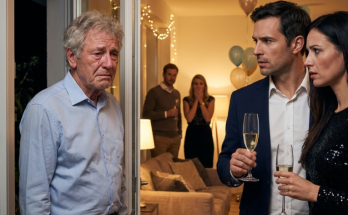
I called the police on my own uncle, and if I had to relive that day a hundred times, I would still make the same call.
People like to imagine family danger as something loud.
A shattered plate.
A fist through drywall.
A scream that shakes the windows.
They do not understand how often real danger wears a clean shirt, smiles politely, and knows exactly how to sound reasonable.
That afternoon began like an accident.
I was working an early shift at the hospital when the scheduling system crashed so badly the charge nurse looked like she might cry.
Half the staff were sent home before lunch because no one could access assignments.
Usually I would have loved that kind of sudden freedom.
I would have bought coffee, wandered the grocery store, maybe sat in my car and enjoyed the unfamiliar silence of an unexpected afternoon off.
Instead, from the moment I walked out to the parking lot, I felt wrong.
Not sick.
Not dizzy.
Just wrong.
A pressure sat under my ribs all morning, small and persistent.
It made me keep checking my phone even when there were no messages.
I told myself I was being dramatic.
I was thirty-one years old, a nurse, an adult who understood stress.
But when I got in my car, I turned toward my mother’s house without even deciding to.
I told myself it was because I had laundry in my trunk and Mom’s dryer worked better than mine.
That was not the truth, or at least not the whole truth.
When I pulled into the driveway, the first thing I noticed was my uncle Dean’s truck.
It sat crooked on the concrete, one tire pushed into the grass.
That alone made me pause.
Dean was exact about everything.
He folded newspaper edges.
He aligned salt shakers in restaurants.
He had once made my brother, Marcus, wipe muddy footprints off a garage floor because “standards matter.” Sloppy parking was unlike him.
I turned off the engine and sat there for a moment, hands on the wheel.
Marcus should have been home by then.
He was thirteen and loud in the effortless way only happy children can be.
He shouted at video games, raided the pantry, bounced a tennis ball off walls he had been told not to touch.
The house around him was never quiet for long.
But that day the house was silent.
Not peaceful.
Pressurized.
I stepped out of the car into the heat.
Across the street, Mrs.
Patel’s sprinkler clicked in a slow arc over her lawn.
Somewhere nearby, someone was mowing.
Everything looked normal.
That made the dread worse.
My key stuck in the front lock, just for a second.
“Marcus?” I called as I stepped inside.
No answer.
The living room lamp was on though sunlight poured through the windows.
A glass of iced tea sweated onto a coaster on the coffee table.
Dean’s baseball cap lay beside it.
Near the stairs sat Marcus’s backpack, half unzipped, a science worksheet poking out.
That bothered me immediately.
Marcus always dropped his bag in the kitchen because food came before everything else.
If his backpack was by the stairs, it meant something had interrupted him the second he got home.
I walked into the hallway.
At first, all I heard
was the refrigerator humming and the old familiar creak of the floorboards.
Then I heard a sound from behind Dean’s office door.
A breath.
Short.
Ragged.
Held too tight.
Then another.
I stopped moving.
Dean used that room whenever he came by to help Mom with paperwork.
Bills, tax folders, insurance forms, whatever boring adult task he liked to manage while making everyone feel incompetent around him.
Last year he had installed a lock on the door, saying my mother needed a private place for sensitive documents.
I remembered joking that he had turned the spare room into a vault.
He smiled and said, “A house needs one room children know not to snoop into.”
At the time, I thought he was just controlling.
Now my little brother was crying behind that locked door.
I knocked once.
The sound inside stopped so fast it was frightening.
“Dean?” I said.
No answer.
Then, through the door, his voice came smooth and calm.
“Diane? Didn’t know you were home.”
That was the moment fear turned into rage.
“Open the door.”
A beat of silence.
“Give me a minute.”
“No.
Open it now.”
The lock clicked.
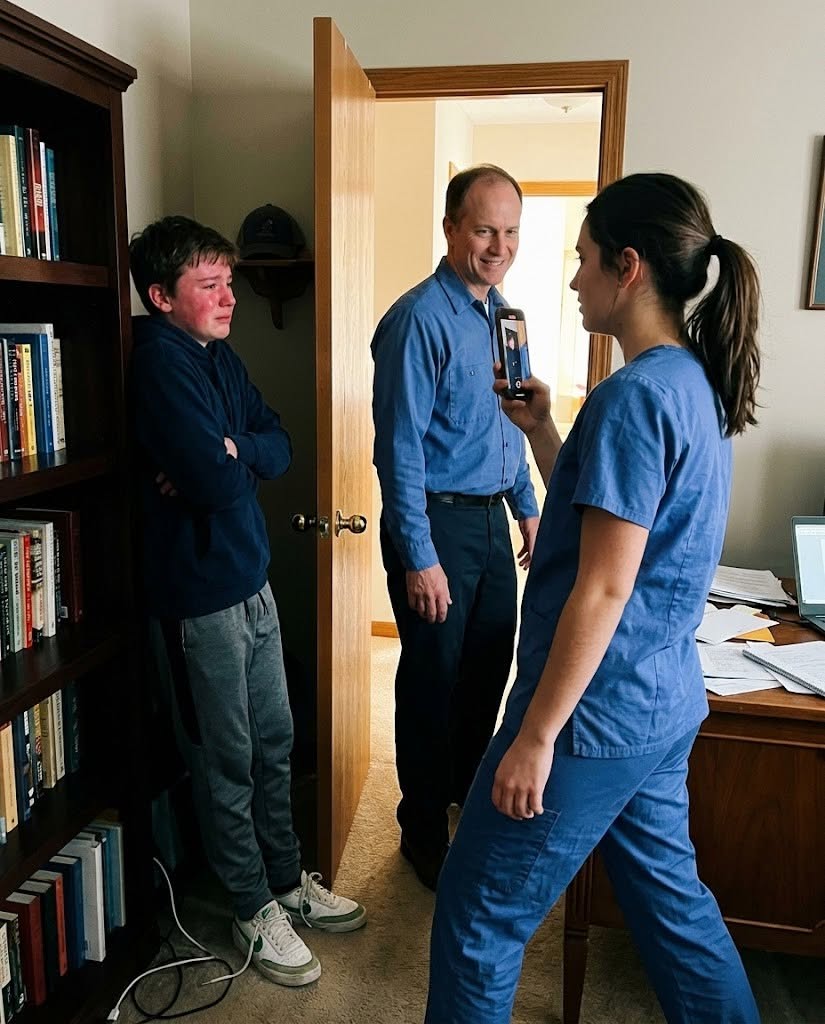
Dean opened the door halfway, his body blocking most of the room.
He wore a blue work shirt with the sleeves neatly rolled.
His hair was combed.
His face held that mildly irritated expression adults use when they want to make you feel childish for interrupting.
Behind him, I saw Marcus.
He was pressed against the far wall beside a bookcase, his arms folded tightly over his chest.
His face was wet and red.
One shoe was untied.
But it was his eyes that undid me.
Relief.
Not embarrassment.
Not annoyance.
Relief so desperate it looked painful.
Dean smiled.
“We were just talking.”
Marcus shook his head once.
Tiny.
Quick.
Almost invisible.
But I saw it.
The room changed in an instant.
“Move,” I said.
Dean kept smiling, but there was strain in it now.
“He got upset.
I was correcting some behavior.
Thirteen-year-old boys can be dramatic.”
Marcus made a sound then, like words were trying to come out and failing.
I stepped forward.
Dean shifted to block me more fully.
“Let’s not turn this into something ugly,” he said softly.
That sentence told me more than he realized.
Guilty people always rush to manage appearances.
I shoved past him.
As Dean’s arm moved, Marcus flinched.
He did not just lean back or blink.
He flinched with his whole body, the way people do when they have already learned what hands can do.
A sickness moved through me so fast I almost staggered.
“Marcus,” I said, holding my hand out.
“Come here.”
He crossed the room immediately and grabbed my wrist with both hands.
He was freezing.
Dean let out a laugh, thin and false.
“See? You’re scaring him more.”
That was when my mother appeared in the hallway, drying her hands on a dish towel.
She stopped when she saw us.
Her face drained of color.
It only lasted a second, but it was enough.
Then she pulled herself together and said, far too brightly, “What is going on?”
I turned toward her.
“Why was Marcus locked in here?”
Her eyes flicked to Dean.
Just once.
Fast.
Still enough.
“He wasn’t locked in,” she said.
“You misunderstood.”
Marcus’s fingers tightened painfully around my wrist.
Dean was smiling again.
I felt something inside me go cold and sharp.
Not confusion.
Not panic.
Clarity.
“Mom,” I said, very carefully, “why is he crying?”
“Because you barged in and made him feel ashamed,” Dean answered before she could.
Marcus whispered, “That’s not true.”
It was barely audible.
I looked at my brother.
“Sweetheart, I need you to say it again.”
His lower lip trembled.
He looked at our mother, then at Dean, then at me.
I watched fear move across his face like a shadow.
Not the fear of getting in trouble.
The fear of what would happen if he told the truth and nobody helped.
I had seen that look in patients before.
Children.
Vulnerable adults.
People trapped with someone stronger.
I took out my phone.
I hit record.
The red light came on.
Dean’s face changed instantly.
Only a little.
His mouth tightened.
His eyes flattened.
But the shift was there.
“Now,” he said softly, “that is unnecessary.”
“No,” I said.
“What’s unnecessary is a grown man standing between a crying child and the door.”
My mother’s voice sharpened.
“Diane, put that away.”
I did not move.
Marcus stared at the phone, at the tiny red dot, as if it were the first good thing that had happened to him all day.
Then he whispered, “Don’t stop recording.”
The room went still.
I felt the hair rise on my arms.
“Why?” I asked him.
He swallowed hard and said, without looking at anyone, “Because he said nobody would believe me.
He said Mom already knew.”
The dish towel slipped from my mother’s hand.
Dean spoke immediately, too quickly.
“He’s upset.
He’s confused.”
“Marcus,” I said, ignoring him, “what happened?”
He shook his head, breathing too fast.
He pointed instead, toward the small closet inside the office.
“My hoodie,” he whispered.
“It’s in there.”
Dean moved.
Fast.
For a man who had been so calm moments earlier, the speed gave him away.
I got there first and yanked the closet door open.
Marcus’s gray hoodie lay crumpled on the floor.
Under it was his phone.
The screen was cracked.
It was still recording.
For half a second no one breathed.
Then Dean lunged for it.
I snatched it up and backed away.
My mother grabbed my forearm.
“Diane, stop this right now,” she hissed.
That was when I knew.
Not suspected.
Knew.
She was not shocked by whatever was on that phone.
She was afraid of it.
I shook her off so hard she stumbled.
“Marcus, behind me,” I said.
He obeyed instantly.
I unlocked his phone with trembling fingers.
There was a video open.
The timestamp showed it had started before I came in.
Dean’s voice came through the speaker, low and smooth.
“If you tell your sister, nobody will believe you.
Your mother didn’t.”
The room went dead silent.
My mother covered her mouth.
Dean stopped smiling.
I turned very slowly toward her.
“You knew?”
Tears sprang to her eyes so fast they looked rehearsed.
“It wasn’t like that,” she said.
“He said Marcus misunderstood affection.
Dean was helping.
He said boys need guidance.
He said—”
“Stop,” I said.
My voice did not sound like mine.
Marcus made a broken sound behind me.
In that
instant I realized the deepest injury in that room was not only what Dean had done.
It was that Marcus had tried to tell someone, and the person who should have protected him had chosen comfort over truth.
Dean lifted both hands, playing calm again.
“You are twisting everything.
There is no context here.”
I stared at him.
“You locked a child in a room.”
“I was talking to him.”
“He was crying.”
“Because he’s emotional.”
“He flinched when you moved.”
For the first time, Dean’s expression hardened.
He looked less like a polite uncle and more like the thing underneath.
“You’re making a serious mistake,” he said.
“No,” I replied.
“You made it.”
I dialed 911.
Mom lunged then, not at Dean, not toward Marcus, but toward me.
“Please,” she whispered.
“Don’t call.
We can handle this privately.”
That sentence will haunt me as long as I live.
Handle this privately.
As if my brother’s terror was a stain on the family rug.
As if silence could protect anyone except the man who caused it.
I stepped away from her and gave the dispatcher our address, my voice steady in the way it gets when something inside you has settled into purpose.
I told her there was a child in distress, that an adult male had locked him in a room, that I had a recording.
Dean did not try to leave.
Men like him often do not.
They believe their respectability will carry them through.
He stood there with his jaw tight and his sleeves still neatly rolled, the picture of offended innocence.
Marcus clung to the back of my scrub top with one hand.
My mother cried softly in the hallway.
It took seven minutes for the police to arrive.
I know because I watched the numbers on my phone.
Seven minutes of Dean saying we were destroying the family.
Seven minutes of Mom whispering that we could fix this without outsiders.
Seven minutes of Marcus staying behind me, saying nothing, breathing like every inhale hurt.
When the officers came in, the performance began immediately.
Dean was calm.
My mother was trembling.
I was the angry daughter with a phone.
For exactly three seconds, I saw one of the officers wonder if he had walked into a family argument blown out of proportion.
Then Marcus stepped out from behind me.
He still looked terrified, but something in him had shifted.
Maybe it was the uniforms.
Maybe it was the fact that the recording existed now, outside all of us.
One officer crouched to his level and asked, very gently, “Can you tell me what happened?”
Marcus looked at me first.
I nodded.
Then he spoke.
Not all at once.
Not perfectly.
But enough.
Enough for one officer’s face to go flat with professional focus.
Enough for the other to ask for the phones.
Enough for Dean to finally understand that his smile had stopped working.
They separated all of us.
One officer took my statement in the kitchen.
Another spoke to Marcus in the living room where I could still see him.
A female officer arrived to stay with him when he began crying again.
Mom kept repeating that she had been confused, that Dean had said it was discipline, that she never meant for anyone to
get hurt.
I could not even look at her.
Because confusion has a sound, and it is not what I had heard in her voice.
What I had heard was avoidance.
What I had seen was permission.
By early evening, Dean was in handcuffs.
He did not resist when they led him out, but he turned his head toward my mother and said, with quiet fury, “You said this would stay handled.”
One of the officers heard him.
So did I.
And so did Marcus.
That sentence was the final crack in whatever story my mother had been trying to tell herself.
She sat down hard on the hallway bench and started sobbing in a way that was almost ugly enough to seem real.
But even then, my first thought was not pity.
It was too late.
Child services became involved that night.
So did a crisis counselor.
Marcus was taken to the hospital for an evaluation because protocol demanded it and because, in truth, I would not let him out of my sight.
I went with him.
He sat in the passenger seat of my car clutching his hoodie in both hands.
Halfway there, he asked, in a voice so small it barely existed, “Are you mad at me?”
I had to pull over.
I turned to him and said, “Marcus, I am only mad that you were left alone in this.”
He cried then.
Not the hard, panicked crying from the office.
The exhausted kind that comes when the body finally believes the danger has passed.
I cried too.
The truth came out in layers over the weeks that followed.
Marcus had tried more than once to avoid being alone with Dean.
He had complained of stomachaches when Dean visited.
He had stayed longer at school, avoided coming home, slept with his bedroom door shoved against a dresser.
My mother noticed all of it.
She asked Dean about it.
He told her Marcus was becoming difficult and manipulative, that fatherless boys get confused, that he was trying to mentor him.
He said modern kids turned everything into drama.
He said Diane would not understand.
He said if she made accusations without proof, she would tear the family apart.
And because believing him was easier than imagining the truth, she believed him.
That may have been cowardice.
It may have been denial.
It may have been both.
Whatever it was, Marcus paid for it.
Criminal charges followed.
More evidence surfaced from Marcus’s phone and from things Dean had sent that he thought had been deleted.
The investigation reached farther than any of us expected.
There were old complaints, whispered concerns, stories from years back that no one had wanted to see as a pattern.
That is how men like Dean survive.
Not by hiding perfectly.
By counting on everyone else to look away.
Marcus came to live with me while the legal process moved forward.
The first few months were hard.
He startled at footsteps.
He hated closed doors.
He apologized for everything, even for asking for cereal, even for coughing too loudly, even for existing in a room.
Trauma rearranges a child in ways that are painful to witness.
But slowly, carefully, he started to come back.
He laughed at stupid videos again.
He argued about screen time.
He left his backpack in the kitchen where it belonged.
The first day I came home and heard him shouting at a game from the couch, I stood in the hallway and cried because noise had never sounded so beautiful.
My mother tried to reach out.
At first she sent long messages full of broken language about guilt, mistakes, shame, prayer, therapy, confusion.
She wanted forgiveness before Marcus had even learned how to sleep through the night.
I did not respond.
Eventually, with Marcus’s therapist guiding the process, he agreed to read a letter from her.
In it she wrote that she had failed him because she wanted the world to stay simple.
She admitted she had chosen comfort over courage.
She did not ask him to fix her.
For once, that mattered.
Healing is not neat.
It is not one apology and a hug and then Christmas dinner in matching sweaters.
Marcus still has days when his face changes because a smell or a tone or a locked door pulls him backward.
I still wake up furious sometimes, thinking of that office, that smile, that sentence.
You misunderstood.
No.
I understood perfectly.
I understood that evil does not always announce itself with monsters’ teeth.
Sometimes it sits in a family home, drinking iced tea, wearing a neat blue shirt, relying on politeness to keep everyone still.
I understood that protection is often one ugly decision made at exactly the right moment.
And I understood that the reason Marcus is here, alive and healing and loud enough to annoy me again, is because one afternoon I came home early, heard one strangled breath behind a locked door, and decided never to stop recording until the truth had nowhere left to hide.
Some people in our family still say I should not have called the police that day.
They say there were other ways.
Quieter ways.
More private ways.
I look at Marcus every time I hear that, and I know exactly who those quieter ways are built to protect.
So I tell them the same thing every single time.
I called the police on my own uncle.
And I would do it again.
Even now, after everything, the part that unsettles me most is not Dean’s smile.
It is how close we all came to letting that smile win.
If I had stopped for coffee, if the scheduling system had not crashed, if Marcus had not hidden his phone, if I had wanted one peaceful afternoon instead of listening to the fear clawing at my ribs—how much longer would he have been trapped inside that house, behind that door, waiting for one adult to believe him?