The first thing I noticed when I woke up was the smell.
Antiseptic.Then burnt vending-machine coffee.

Then the sharp plastic scent of the oxygen tube brushing the side of my face every time I tried to breathe without making my ribs hurt.
For a few seconds, I did not know where I was.
The ceiling above me was too white.
The fluorescent lights hummed so loudly it felt like they were inside my skull.
My body felt far away, as if it had been carried into that room without asking me first.
Then the pain found me.
It started in my shoulder and tore down my arm with such force that I gasped before I even opened my eyes.
My arm was strapped in a sling.
My ribs tightened every time I inhaled.
One side of my face was so swollen I could barely see through it, and my jaw ached like I had been chewing stone all night.
“Sweetheart,” my mother whispered.
Her voice broke on the word.
“Thank God. Thank God you’re awake.”
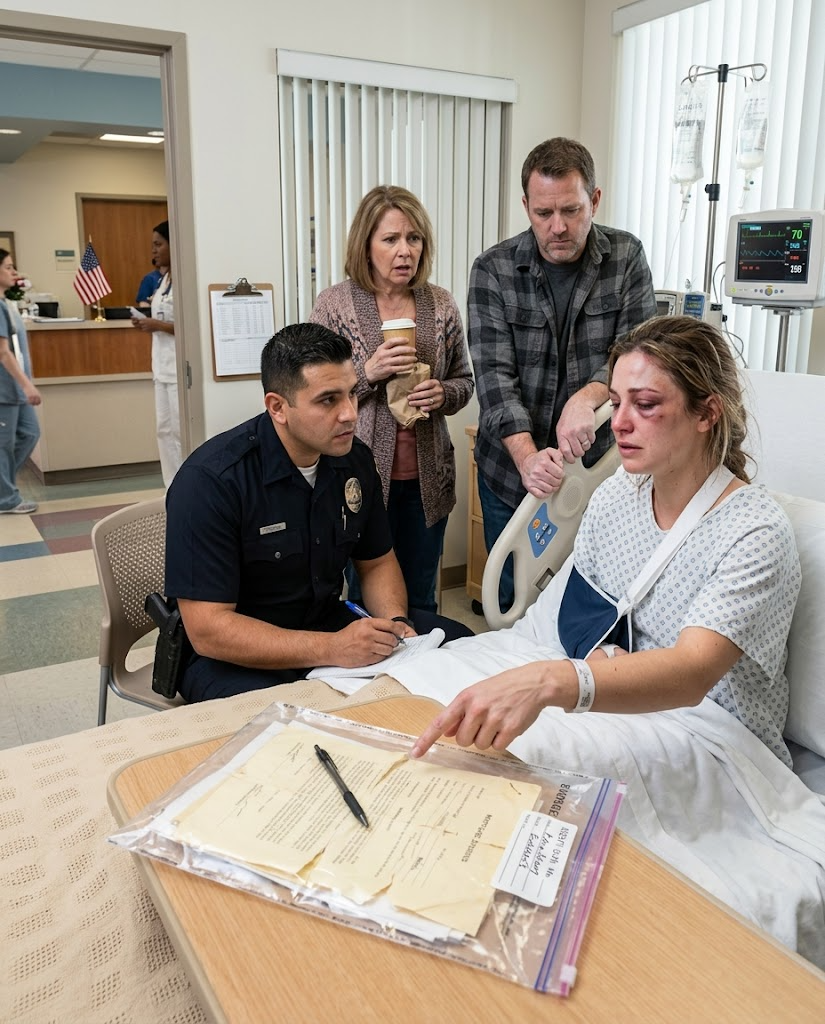
She was sitting beside the bed in a plastic chair, holding a paper coffee cup with both hands.
The cup was crushed on one side where her fingers had caved it in.
My father stood behind her, gripping the back of the chair.
He still wore the brown work jacket he kept in the garage, the one with sawdust caught in the seams and a small tear near the cuff.
He looked hollow.
Not tired.
Hollow.
Like the night had reached inside him and removed something he did not know how to replace.
Beside the bed sat a police officer with a notebook on her lap.
Her uniform was neat.
Her face was calm in the practiced way of someone who had seen enough terrible things to know that rushing a victim never helped.
“I’m Officer Ramirez,” she said softly. “You’re safe now.”
Safe.
I almost laughed.
The sound caught in my ribs before it could come out.
Less than twenty-four hours earlier, I had been standing in my parents’ garage while my sister tried to convince me to put my name on her mortgage.
Not advise her.
Not help her compare banks.
Sign.
Tie my credit, my income, my future, and my legal responsibility to a house she and her husband could not qualify for on their own.
Two weeks before the hospital, Jillian had called me while I was standing in my apartment kitchen.
My dishes were stacked in the sink.
My phone had just buzzed with a rent reminder.
I remember that because the whole conversation started while I was staring at my own bills and trying not to feel behind.
Jillian sounded cheerful.
Too cheerful.
“Just co-sign it,” she said. “It’s not even that serious.”
I leaned against the counter and closed my eyes.
“Jillian, no.”
There was a pause on the line.
Then came the shift.
I knew that tone.
She had used it since we were kids, anytime she wanted the room to turn against whoever had disappointed her.
“Why are you acting like this?”
“I’m not acting like anything,” I said. “I’m saying I can’t put my name on your mortgage.”
“It’s paperwork.”
“It’s debt.”
“Banks make everything complicated. Colton says they just need another name to push it through.”
That sentence told me more than she meant it to.
Another name.
Not my help.
Not my trust.
My name.
I had spent years protecting that name on paper.
I worked overtime whenever my office offered it.
I drove an old car with a cracked cup holder because the payment had been gone for three years.
I cooked most of my meals at home.
I kept a spreadsheet for utilities, rent, car insurance, groceries, and the little emergency fund that had taken me longer to build than I admitted to anyone.
It was not glamorous.
It was not impressive.
But it was stable.
And stability matters more when you know what it costs to earn it.
“If you could afford the house,” I told her, “you would not need me attached to it.”
Her voice went cold.
“You don’t even have kids. What exactly are you protecting?”
My future.
My credit.
The small life I had built one exhausted paycheck at a time.
But I did not say all that.
People who feel entitled to your sacrifice rarely respect the explanation.
They only hear the no.
Three days later, my mother called.
Her voice was softer than usual.
“Can you come by for dinner Thursday? Your sister is upset, and we need to work this out.”
That should have warned me.
My mother never said “work this out” unless she already knew someone was planning to corner me.
Still, I went.
Family pressure does not always feel like a fist at first.
Sometimes it sounds like your mother asking you to stop by after work.
At 6:18 p.m. on Thursday, I pulled into my parents’ driveway.
The porch light was already on, although the sun had not fully gone down.
My father’s old pickup sat by the garage.
A small American flag beside the front steps tapped softly against its pole in the evening wind.
There was no smell of dinner when I walked in.
No onions.
No roast.
No plates on the kitchen table.
My mother was not in the kitchen.
The garage door to the house was open.
I heard Colton’s voice before I saw him.
“See? She came.”
The garage smelled like cold concrete, motor oil, and sawdust.
My father’s tools hung on the pegboard above the workbench.
A folding table had been set up in the middle of the floor.
Mortgage papers were stacked neatly on top of it.
A black pen lay across the signature page.
Jillian stood beside Colton with her arms folded.
She was dressed like she had come from some important appointment, hair smooth, nails polished, mouth tight.
Colton leaned against the workbench in a dark jacket and jeans, smiling like he was trying to look patient for an audience.
My mother stood near the garage refrigerator with a dish towel twisted in both hands.
My father would not look at me.
No dinner.
A setup.
Colton lifted one hand as if he were calming a room before anyone had raised their voice.
“Let’s not make this dramatic.”
Jillian slid the papers toward me.
“Just sign it.”
I looked at the stack.
The top page had lender boxes, typed borrower information, and a date printed across the top.
I saw my name.
Not handwritten.
Typed.
For one second, my brain refused to accept it.
I looked from the paper to Jillian.
“What is this?”
“It’s the loan packet,” she said, like I was stupid.
“Why is my name already in it?”
Colton’s smile tightened.
“Because that’s how they draft it when you’re part of the application.”
“I’m not part of the application.”
“You will be when you sign,” Jillian said.
My mother’s eyes filled instantly.
“Please don’t fight,” she whispered.
That was always the request.
Not please be honest.
Not please stop pressuring your sister.
Just please don’t fight.
The garage froze around us.
My mother’s coffee mug sat untouched on a shelf.
A wrench hung crooked from the pegboard.
The old refrigerator hummed behind us.
A radio near the toolbox had gone silent between songs.
Nobody moved.
I pushed the papers back across the folding table.
“No.”
Jillian’s face changed so fast it scared me.
Not hurt.
Not surprised.
Furious.
“Do you even realize what you’re doing to us?”
“You are not entitled to my credit,” I said. “Or my future.”
Colton pushed off the workbench.
“You seriously think you’re better than us?”
I took one small step back.
That was the only warning I got.
He hit me across the face so hard the garage light turned white.
My shoulder slammed into the metal shelf behind me.
Tools clattered down around my feet.
Before I could steady myself, Colton grabbed my arm and twisted it upward and back.
I heard the pop before I understood the pain.
Then I screamed.
My knees hit the concrete.
My good hand scraped through sawdust.
The mortgage papers slid from the folding table and scattered near my face.
Jillian did not help me.
She stood there breathing hard, arms crossed, watching me as if I had finally become the problem she always said I was.
“Maybe now,” she said, “you’ll stop being selfish.”
For one ugly heartbeat, I wanted to reach for the wrench near my hand.
I wanted to swing.
I wanted the whole garage to feel what they had asked me to swallow.
I did not.
I pressed my good palm against the concrete and tried to breathe.
My father shouted my name.
My mother started sobbing.
Colton kicked the papers toward me.
“Sign,” he said.
The neighbor’s dog began barking through the fence.
A car door slammed somewhere outside.
The next thing I remember clearly is the sound of my mother yelling, “Call 911,” and my father saying, over and over, “I should have stopped this.”
According to the police report filed later, the 911 call came in at 6:41 p.m.
The woman next door told dispatch she heard screaming from my parents’ garage.
She also said she heard a man yelling about paperwork.
That detail mattered later.
So did the papers.
By the time the paramedics arrived, I was curled on the garage floor tasting blood.
Jillian stood near the workbench.
Colton kept saying, “She fell.”
He said it three times before anyone asked him a question.
People who tell the truth do not usually rehearse it that fast.
At the hospital, they reduced my shoulder and put my arm in a sling.
The nurse cleaned my face.
Someone asked me pain-scale questions I could not answer without crying.
The hospital intake form marked my injuries as consistent with reported assault.
Officer Ramirez arrived before sunrise.
That was when I woke up to my mother, my father, and the notebook waiting beside me.
“Who did this to you?” Officer Ramirez asked.
My throat burned.
“My brother-in-law,” I said.
My mother made a broken sound.
My father closed his eyes.
Officer Ramirez wrote it down.
Her pen moved steadily across the page.
“And what happened before he assaulted you?”
I swallowed through the pain.
“My sister and her husband wanted me to co-sign a mortgage.”
The officer looked up.
“Did you agree?”
“No.”
“Had you agreed at any point before that night?”
“No.”
“Had you provided them financial documents?”
“No.”
That was when my father shifted behind my mother.
I saw it even through the swelling in my eye.
A small movement.
A flinch.
I turned my head as far as the pain allowed.
“Dad?”
He covered his mouth with one hand.
“I picked up some of the papers after the ambulance took you,” he said.
My mother turned to him.
“What?”
“I didn’t know what else to do.”
Officer Ramirez became very still.
“Where are they now?”
“In the truck,” my father whispered. “I put them in an envelope.”
The officer stood.
“I need you to bring those in.”
He left the room so quickly the chair behind him scraped against the floor.
My mother started crying harder.
Not loudly.
That was worse.
Her shoulders just folded inward, and she stared at the coffee cup in her hands as if it had become the only object in the room she could understand.
When my father came back, he was with another officer.
The second officer carried a clear evidence bag.
Inside was a wrinkled mortgage page, a black pen, and a folded yellow envelope.
On the front of the envelope, in Jillian’s handwriting, was one word.
Copies.
My stomach dropped so hard the monitor beside me jumped.
Officer Ramirez set the bag on the rolling tray beside my bed.
She did not open it in front of me.
She simply angled it enough that I could see the top page.
My name was there.
Typed in the borrower section.
Not co-signer.
Borrower.
I stared at it until the letters blurred.
“My name was already on it,” I whispered.
My father gripped the bed rail.
My mother shook her head slowly, like denial could still save us if she moved carefully enough.
Officer Ramirez asked, “Did you ever give your sister permission to use your Social Security number, pay stubs, bank statements, or employment information for a loan application?”
“No.”
“Did you ever give her access to those documents?”
I almost said no again.
Then I remembered.
Three months earlier, Jillian had asked me to email her a copy of my most recent pay stub because she was “comparing job benefits” and wanted to see how my company listed deductions.
It had sounded harmless.
Sisters ask each other things like that.
At the time, I had sent it without thinking.
Trust is rarely stolen all at once.
Sometimes you hand it over in one ordinary email, never imagining someone you love is saving it for later.
“I sent her one pay stub,” I said.
Officer Ramirez’s face changed again.
“When?”
“About three months ago.”
“By email?”
“Yes.”
“Forward that email to yourself somewhere safe when you’re able,” she said. “And do not delete anything.”
My father made a sound like he had been punched.
“I didn’t know,” he whispered.
I believed him.
That did not make it better.
Officer Ramirez took my statement in pieces because I kept having to stop for pain medication and nausea.
She documented the time of the original call from Jillian.
She documented the dinner invitation.
She documented the garage setup, the folding table, the papers, the pen, Colton’s demand that I sign, and Jillian’s words after he hurt me.
She wrote “mortgage packet” and “possible unauthorized use of identifying information” in her notes.
Those phrases sounded too clean for what had happened.
Too calm.
But that is what paperwork does.
It turns screaming into sentences other people can act on.
By the time Jillian arrived at the hospital waiting room, she had already decided she was the victim.
I did not see her at first.
I heard her.
She was crying loudly near the nurses’ station, telling someone, “This is being blown out of proportion.”
Officer Ramirez stepped into the hallway.
My father followed her.
My mother stayed beside me, frozen.
Through the open door, I heard Jillian say, “She always does this. She makes everything about herself.”
Then I heard my father.
His voice was low, but it shook.
“Your husband put your sister in a hospital.”
Jillian said, “Colton barely touched her.”
That sentence broke something in me more completely than my shoulder.
Not because it surprised me.
Because it did not.
My mother started to stand.
I reached for her with my good hand.
“Don’t.”
She looked down at me.
Her face was wet.
“She’s my daughter too,” she whispered.
“I know.”
For once, that was the problem.
Officer Ramirez came back in a few minutes later.
She did not tell me everything.
She could not.
But she told me enough.
Colton had left my parents’ house before officers arrived there.
A patrol unit was sent to find him.
Jillian had been told not to enter my room.
The mortgage documents would be photographed, logged, and attached to the initial report.
The email I had sent with the pay stub would matter.
So would any bank statements or identity documents Jillian might have obtained.
“Do I need a lawyer?” I asked.
Officer Ramirez did not pretend.
“It would be wise to talk to one,” she said. “And to contact your bank, your employer’s payroll department, and the credit bureaus as soon as you are able.”
The next hours became a blur of phone calls and pain medication.
My father called my manager from the hallway because I could barely speak.
My mother wrote down numbers on the back of a hospital discharge sheet.
I froze my credit from the hospital bed with one good hand and the screen brightness turned low because my swollen eye could not handle the glare.
I called my bank.
I called payroll.
I forwarded the old pay-stub email to a new folder and took screenshots of the date and time.
The email had been sent at 9:12 p.m. on a Tuesday.
Jillian had replied with a heart emoji and the words, “You’re the best.”
I stared at that message longer than I should have.
You’re the best.
Three months later, she stood over me on a garage floor and called me selfish.
My father went back to the house that afternoon with police permission to collect the rest of the scattered papers from the garage floor.
He did not go alone.
He told me later that the folding table was still there.
The pen was gone.
The garage smelled like oil and bleach because my mother had tried to scrub blood off the concrete before realizing she should not touch anything else.
That detail haunted her.
It still does.
She kept apologizing for cleaning.
I kept telling her the blood was not the important evidence.
But mothers do not always understand evidence when they are trying to undo the sight of their child on the floor.
Two days later, an investigator called me.
The loan packet had more than my name.
It had my employer listed.
It had an estimated income close enough to my real salary to make my skin go cold.
It had a previous address I had not lived at in four years.
It had a phone number that was not mine.
It had an email address made from my name with two extra numbers at the end.
That was the detail that made the room tilt.
Someone had created a version of me that could receive messages I would never see.
Not a misunderstanding.
Not rushed paperwork.
A plan.
The investigator asked whether I recognized the phone number.
I did.
It was Colton’s old work phone.
I had seen it on my sister’s kitchen counter months before, cracked screen and all, while she complained that he never remembered to charge it.
When I said that, the investigator went quiet for a moment.
Then she asked me to repeat it.
So I did.
There are moments when the truth stops being emotional and becomes mechanical.
Dates.
Numbers.
Forms.
A fake email.
A phone number.
A signature line waiting for a hand that was never supposed to question why the page had already been prepared.
Colton was arrested first on the assault charge.
I learned that from my father, who stood in my apartment doorway three days after I was discharged, holding a paper grocery bag full of soup containers my mother had sent.
He looked embarrassed by the bag, like food was too small an offering for what he had failed to stop.
“They picked him up,” he said.
I nodded.
I did not feel triumphant.
I felt tired.
My shoulder throbbed in its sling.
My face was changing colors by the hour.
Purple near my eye.
Yellow at the edge of my cheek.
Red along my jaw.
The body keeps records even when people ask you to move on.
Jillian called me seventeen times that week.
I did not answer.
Then she texted.
You’re destroying my family.
I stared at the message in my kitchen, standing beside the same sink where she had first asked me to co-sign.
My apartment was quiet.
The rent reminder was gone because I had paid it.
The dishes were clean because I had washed them slowly, one-handed, refusing to let my own life fall apart because she had tried to invade it.
I typed one sentence back.
You did that when you put my name on papers I never approved.
Then I blocked her.
My mother cried when I told her.
My father did not.
He just nodded.
The investigation did not move as fast as my anger wanted it to.
Nothing official ever does.
There were statements.
Follow-up calls.
Screenshots.
Copies of emails.
Requests for documents.
A fraud alert.
A certified letter to the lender stating that I had not authorized the application, had not consented to the use of my identifying information, and would not accept responsibility for any debt connected to that packet.
I signed that letter with my left hand because my right shoulder still could not move properly.
My signature looked wrong.
That made me cry harder than I expected.
Not because of the letter.
Because even my name looked injured.
Weeks later, I saw Jillian for the first time after the hospital in a courthouse hallway.
Not a named courthouse from some TV show.
Just a regular county building with beige floors, metal detectors, vending machines, and an American flag standing near the wall.
She looked smaller than she had in the garage.
Colton looked angry.
That part had not changed.
He would not look at me directly.
His attorney did the talking.
Jillian cried when she saw my sling.
I could not tell whether the tears were for me, for herself, or for the fact that other people were now watching.
My mother sat beside me.
My father sat on my other side.
For a long time, none of us spoke.
Then my father leaned close and whispered, “I am sorry I didn’t stand between you and him.”
I looked at his hands.
They were folded in his lap.
Work hands.
Scarred knuckles.
A small bandage near his thumb from some garage project he had probably done to avoid thinking.
“You should have,” I said.
His eyes filled.
“I know.”
That was the first apology in my family that did not come with an excuse attached.
I accepted it slowly.
Not all at once.
Healing is not a door you walk through.
It is a hallway you keep choosing not to turn back from.
The mortgage application did not go through.
The lender flagged it after the police report and my certified dispute.
The fake email account became part of the file.
So did the old work phone number.
So did the pay-stub email Jillian had requested under a lie.
I was told there would be consequences beyond Colton’s assault charge, but I learned not to build my peace around the speed of other people’s accountability.
I focused on physical therapy.
On sleeping through the night.
On opening my mailbox without feeling sick.
On checking my credit report every week until the panic stopped arriving before the page loaded.
My mother kept bringing food.
At first I did not want it.
Then one afternoon she showed up with chicken soup, paper towels, and a new shower brush because I could not lift my right arm.
She did not ask me to forgive Jillian.
She did not say “but she’s your sister.”
She set the bag on my counter and said, “I should have protected you from the setup before it became violence.”
I believed her because she did not ask for comfort after saying it.
That mattered.
Jillian eventually sent a letter.
Not a text.
A real letter, folded into an envelope with my name written in her handwriting.
I knew that handwriting too well.
It was the same handwriting from the yellow envelope marked copies.
I did not open it for two days.
When I finally did, the first line was, I never meant for Colton to hurt you.
I set it down.
That was not the apology I needed.
Maybe it was the only one she knew how to write.
Maybe someday she would understand that the beating had only been the loudest part of what they had done.
The betrayal had started earlier.
With the phone call.
With the pay stub.
With the typed name.
With the assumption that my future was a family resource and my refusal was the real crime.
I kept the letter in the same folder as the police report, the hospital discharge papers, the credit freeze confirmations, the certified lender dispute, and the screenshots.
Not because I wanted to live inside the injury.
Because I had spent too many years letting my family rewrite things after they hurt me.
This time, the record stayed.
Sometimes people think boundaries are cruel because they only notice them after they have spent years stepping over the line.
I used to think saying no would cost me my family.
I was wrong.
Saying no showed me which parts of my family had already been willing to lose me, as long as they could keep using me.
Months later, my shoulder still ached when it rained.
My eye healed.
My credit stayed clean.
My apartment stayed mine.
And every time I paid my rent from my own account, with my own name untouched by their loan, I remembered the garage floor and the hospital lights and Officer Ramirez asking for the truth.
An entire family had tried to make me feel selfish for protecting the only stable life I had.
But I was not selfish.
I was awake.
And for the first time in years, I stayed that way.